
Introduction
Starting point
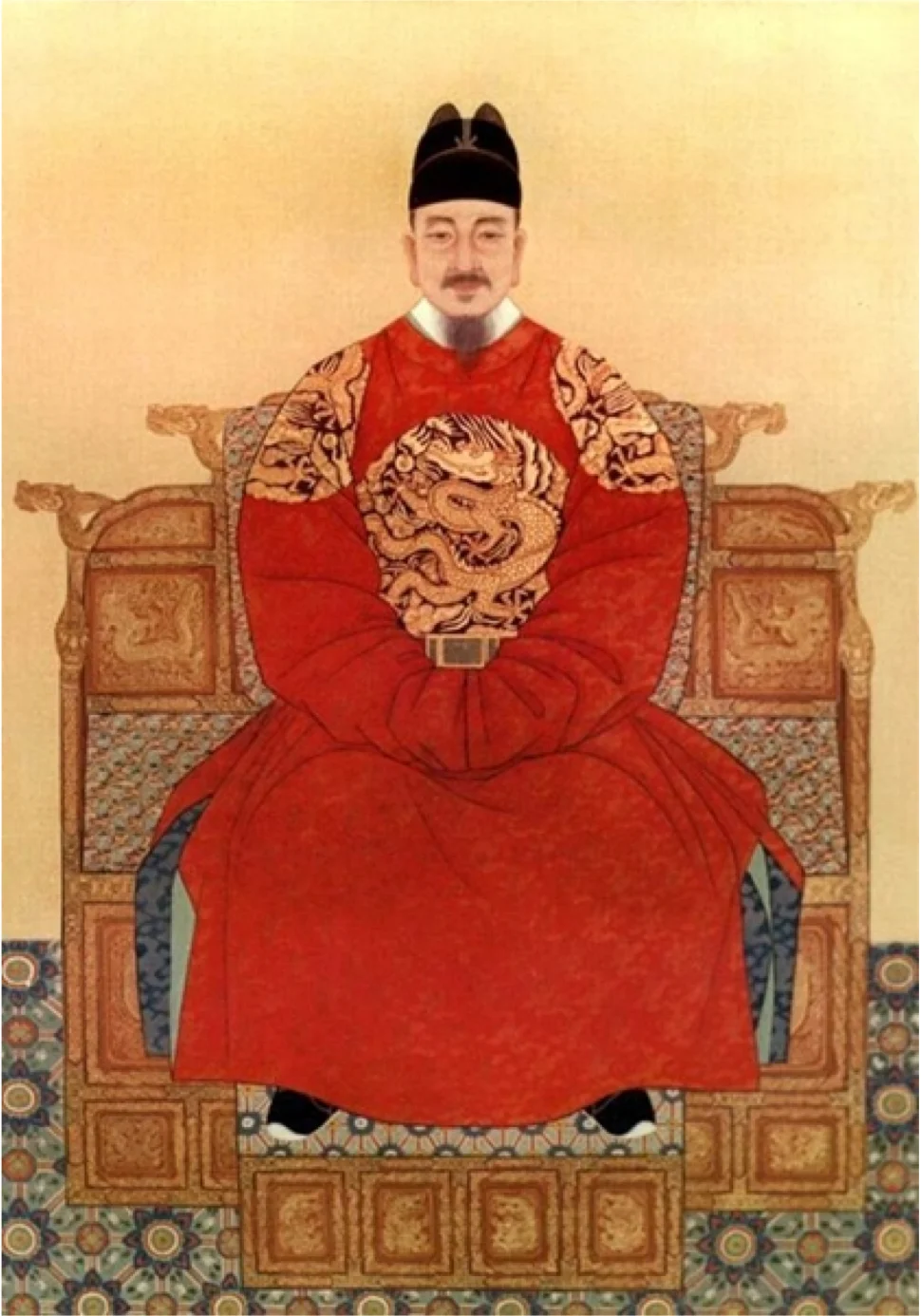
My inquiry began with the portrait of King Sejong. I was struck by how one colour could define his identity so completely; the deep red colour of the robe he wears was the first thing I thought of when I heard his name, not his face or his achievements. I had taken for granted that colour could be assigned to power. This made me ask whether each culture, or even broader “world” such as the Classical world, might have a certain colour that acts like red in Korea.
Prediction
I predict that the colour purple will prove to be the Roman counterpart to Korean royal red. The purpura, and that Roman authors will present it as belonging to those at the top of the political and social order, for example kings, generals, and statesmen, and ultimately emperors. As in Joseon Korea, I expect its use to be restricted by custom and eventually more systematically by law, so that wearing it without entitlement counts as presumption or even a political threat.
Source 1 (150)
sed purpurae florem illum tinguendis expetitum vestibus in mediis habent faucibus. liquoris hic minimi est candida vena, unde pretiosus ille bibitur nigrantis rosae colore sublucens; reliquum corpus sterile. vivas capere contendunt, quia cum vita sucum eum evomunt.
But it has the famous flower of purple, sought after for dyeing robes, in the middle of its throat: here there is a white vein of scantest fluid from which that precious dye, suffused with a dark rose colour, is drained, but the rest of the body produces nothing. People strive to catch them alive, because it discharges this juice with its life.
– Pliny the Elder, Naturalis Historia 9.125–126
In his encyclopaedia, Naturalis Historia, Pliny the Elder records what an educated Roman would have understood about the production of purple dye from a type of shellfish called murex, showing how Romans themselves explained the basis of purple’s prestige. Pliny first presents purple, purpura, as hidden deep inside the throat of murex, suggesting that it is almost secretive and difficult to obtain. Then he describes it as liquoris hic minimi, meaning that each shellfish only produces the barest amount of purple liquid. He further emphasises the difficulty of the process by explaining that the shellfish must be caught alive for the dye to be released. Therefore, this excerpt posits the reason for purple’s extremely high value first came from its natural scarcity and its labour-intensive production. This also suggests that the Romans were cognisant of this material scarcity and valued purple because of it, similar to how people value gold.
Source 2 (136)
ibi Masinissam, primum regem appellatum eximiisque ornatum laudibus, aurea corona aurea patera sella curuli et scipione eburneo toga picta et palmata tunica donat. addit uerbis honorem: neque magnificentius quicquam triumpho apud Romanos neque triumphantibus ampliorem eo ornatum esse quo unum omnium externorum dignum Masinissam populus Romanus ducat.
Addressing Masinissa as king and eulogising him in the highest possible terms, he presented him with a golden crown, curule chair, an ivory sceptre and also with a purple-bordered toga and a tunic embroidered with palms. He enhanced the value of these gifts by informing him that the Romans considered no honour more splendid than that of a triumph, and that no more magnificent insignia were borne by triumphing generals than those which the Roman people deemed Masinissa, alone of all foreigners, worthy to possess.
– Livy, Ab Urbe Condita 30.15.11–12
In Ab Urbe Condita, Livy delineates purple clothing as a symbol that goes beyond material rarity into a marker of power embedded within the Roman hierarchy itself. When Scipio Africanus formally recognises Masinissa as the king of Numadia, he gifts him toga picta et palmata tunica, the purple robe of Rome’s kings and the triumphing generals. The robe’s value rests on the recognition of the people, for the Romans there is nothing more magnificent than triumphing, neque magnificentius quicquam triumpho. The purple robe is not a decoration or a mere symbol that celebrates being a king but rather it is the visual evidence that confers his kingship. When wrapped in the purple picta toga Masinissa is an apparent king or equivalent in the Roman eyes, showing how high purple sat on the Roman scale of status.
Source 3 (186)
purpura uiri utemur, praetextati in magistratibus, in sacerdotiis, liberi nostri praetextis purpura togis utentur; magistratibus in coloniis municipiisque, hic Romae infimo generi, magistris uicorum, togae praetextae habendae ius permittemus, nec id ut uiui solum habeant insigne sed etiam ut cum eo crementur mortui: feminis dumtaxat purpurae usu interdicemus?
We, their husbands, shall wear purple, the toga praetexta will mark those holding magisterial and priestly offices, our children will wear it, with its purple border; the right to wear it belongs to the magistrates in the military colonies and the municipal towns. Nor is it only in their lifetime that they enjoy this distinction; when they die they are cremated in it. You husbands are at liberty to wear a purple wrap over your dress, will you refuse to allow your wives to wear a purple mantle?
– Livy, Ab Urbe Condita 34.7.2–3
In this passage, Livy records a speech by the tribune Valerius, who is arguing that the Lex Oppia should be repealed. This was a war time law that restrict what women could own and wear, including purple clothingh. Velraius lists everyone in ROme who already has the right to wear purple, and then asks why women alone should be denied. Livy reveals on behalf of him that men wear purple in the magistracies and priesthoods, even in their childhood wearing toga praetexta. Even the infimo generi meaning the lowest class has the right to wear purple. Valerius delivers his question: You husbands are at liberty to wear a purple wrap over your dress, will you refuse to allow your wives to wear a purple mantle? This question shows that purple was the official colour of public standing at every level of Roman society, from the lowest to the highest, and it was so much part of man’s identity that it accompanied him into death. The second is that the access to purple was serious enough to be decided by laws and bated over by the people.
Source 4 (155)
Te greges centum Siculaeque circummugiunt vaccae, tibi tollit hinnitumapta quadrigis equa, te bis Afromurice tinctae
vestiunt lanae; mihi parva rura etspiritum Graiae tenuem CamenaeParca non mendax dedit et malignumspernere volgus.
A hundred herds of Sicilian cattlelow around you, mares fit for the chariotbring you their neighing, you’re dressed inwool: African purple
has stained it twice: truthful Fates, ‘theSparing Ones’,the Parcae, gave me a littleestate, and the purified breath of Greeksong, and my scorn for the spiteful crowd.
– Horace, Odes 2.16.35–37
Here in Odes II, Horace presents purple as a badge of material wealth without inner contentment. He lists everything his rich addressee Grosphus owns: the hundred herds, the racing mare, and finally the purple cloth. And not just any purple. Horace climatically ends the list on bis Afro murice – wool that is doubled-dyed in African purple, the most expensive grade even among shades of purple – marking the very top of the wealth scale. Again, the ordering is deliberate: a piece of purple cloth is presented as the most treasured possession that outweighs even a hundred of cattle which shows how Roman authors ranked its value. But Horace goes one step further by presenting purple as the highest social marker but at the same time as a sign of excess. By setting it against Horace’s own frugal parva rura, his small fields, he suggests that wise man declines purple because the fulfilment it offers is superficial.
Source 5 (210)
Stetit soleatus praetor populi Romani cum pallio purpureo tunicaque talari muliercula nixus in litore. Iam hoc istum vestitu Siculi civesque Romani permulti saepe viderant.
That Roman governor stood there on the shore in slippers, wearing a purple Greek cloak and a long-skirted tunic, and leaning on one of his women ; and often enough before that had any number of Sicilians and Romans citizens seen him in this costume.
– Cicero, In Verrem 2.5.86
In this passage, Cicero is prosecuting Verres, the ROman governor of Sicily for corruption, and he paints a picture tailored to shock the jury. A praetor of the Roman people stands on a beach wearing slippers, a purple cloak, and leaning on a courtesan. To a Roman audience, every detail of this costume comes wrong. A magistrate on duty should wear the toga, the formal dress of the Roman office. Instead Verres wears a pallium, a Greek cloak meaning that the governor now dresses like the people he governs. The slippers are indoor shoes, the long tunic is considered effeminate, and the woman beside him completes the image of a man at leisure rather than at work. The colour purple, the most expensive colour, on a foreign cloak shows that Verres had poured the wealth and standing of his office into luxury. The purple still characterises its weather as a rich and important man, But the coined meaning attached to purple demonstrates Verres’s power while opening up a discussion about his legitimacy whether he deserves the power. This source therefore shows a limit of purple as a status symbol, where it can suggest the prestige to everyone who sees it, but cannot guarantee the worth of the man wearing it.
Source 6 (155)
Ptolemaeum, de quo rettuli, et arcessitum e regno et exceptum honorifice, non alia de causa repente percussit, quam quod edente se munus ingressum spectacula convertisse hominum oculos fulgore purpureae abollae animadvertit.
After inviting Ptolemy, whom I have mentioned before, to come from his kingdom and receiving him with honour, he suddenly had him executed for no other reason than that when giving a gladiatorial show, he noticed that Ptolemy on entering the theatre attracted general attention by the splendour of his purple cloak.
– Suetonius, Caligula 35
In this passage, Suetonius presents purple as a symbol that is so charged with power that wearing it too visibly before the emperor could get you killed. Ptolemy of Mauretania, a client king and Caligula’s own cousin was summoned to Rome to receive an honour, and then he was suddenly executed for one reason: fulgore purpureae abollae, the splendour of his purple cloak, had captured the crowd’s eyes and turned them to him as he entered the theatre. The context of Ptolemy being the king of a purple-producing region, and one of the wealthiest client rulers in the empire opens the possibility that Caligula’s true motive was that wealth. Yet even if it was simple jealousy, the colour purple held such material value that an emperor could covet it, and such visual power that it could turn every eye in a theatre, enough either way to make the most powerful man in Rome feel rivalled.
Source 7 (147)
Et cum interdixisset usum amethystini ac Tyrii coloris summisissetque qui nundinarum die pauculas uncias venderet, praeclusit cunctos negotiatores. Quin etiam inter canendum animadversum matronam in spectaculis vetita purpura cultam demonstrasse procuratoribus suis dicitur detractamque ilico non veste modo sed et bonis exuit.
He demanded the return of the rewards which he had given in recognition of the prizes conferred on him by any city in competition. Having forbidden the use of amethystine or Tyrian purple dyes, he secretly sent a man to sell a few ounces on a market day and then closed the shops of all the dealers. It is even said that when he saw a matron in the audience at one of his recitals clad in the forbidden colour he pointed her out to his agents, who dragged her out and stripped her on the spot, not only of her garment, but also of her property.
– Suetonius, Nero 32.3
In this excerpt, Suetonius shows that Nero tried to control both the wearing and selling of purple. Nero first banned the use of amethystune and Tyrian colours through interdixisset usum amethystini ac Tyrii coloris. Nero then arranged for a small amount of the dye to be sold at the market and used this to close down the dealers, showing that his control extended beyond clothing to the trade and economy revolving around purple itself. The phrase vetita purpura cultam describes a woman as “dressed in forbidden purple,” which shows that purple had become restricted in legal terms rather than just prestigious and expensive. Suetonius then records that the woman above was immediately stripped out of her purple clothes. Although Suetonius uses this episode to criticise Nero, the passage still shows how far purple moved from being a rare luxury to an exclusive monopoly of the imperial power.