
1. INTRODUCTION: THE CRAFT AND ITS GOVERNING CHEMISTRY
Hongyeom (紅染) denotes red dyeing obtained from the safflower, Carthamus tinctorius; its deepest and most prestigious grade is daehong (大紅, "great red"), the colour reserved in the Joseon court for the highest ranks. A master of this dyeing is a hongyeomjang (홍염장). The sequence set out below reconstructs the full working process recorded for Kim Gyeong-yeol, the holder designated by the Seoul Metropolitan Government in 2017, whose practice descends through apprenticeship in his maternal grandfather's silk-thread dyeing workshop (Yun 2019, pp. 6, 118).
Every parameter of the craft follows from one fact about the plant. The safflower floret carries two distinct pigment fractions: a copious yellow that is freely water-soluble, and a scarce red that dissolves only under alkali. In safflower dyeing the yellow is treated as a contaminant of red purity and is deliberately washed away; the red alone is the target. Because the red will only leave the petal into an alkaline liquor, it is drawn out with plant-ash lye; because it is degraded by heat, that liquor is worked cold; and because it will only fix to fibre when the liquor is re-acidified, an acid is added at the moment of dyeing to throw the pigment down onto the cloth. Alkali, acid, and low temperature are therefore not incidental but the three axes of the whole process (Yun 2019, p. 79).
2. BOTANICAL SOURCE AND CULTIVATION OF SAFFLOWER
Safflower (Carthamus tinctorius; Korean 잇꽃 / 홍화 / 홍람 紅藍) is an annual of the Asteraceae. Its florets have long served both as a materia medica and as the principal source of red dye, while the seed oil is used as food (Yun 2019, p. 32). Sowing is done in soft, fertile ground in late February or early March, with a secondary late-May sowing for a July bloom; the tradition, recorded in Bak Se-dang's Saekgyeong (穡經, 1676), holds that spring sown, July-picked florets yield the most saturated colour and the best resistance to fading (Yun 2019, pp. 32-33). The holder grows his own crop at the Danyang workshop and rents additional village plots to secure stock, since a wet, overcast season sharply depresses both plant vigour and floret yield.
3. HARVEST, DRYING, AND THE TWO ROUTES FOR PRESERVING THE COLOURANT
Because the harvest coincides with the summer monsoon while dyeing is carried out in autumn, the colour-bearing material must be carried across several months. This is the point at which the craft divides into two independent preservation routes. They are alternatives, not successive stages: a dyer may work from stored dried flowers, or from fermented pigment cakes, and the two yield perceptibly different results (Yun 2019, p. 108).
3.1 Harvest and drying
Only fully opened florets that still hold red within the yellow are taken, picked by hand one at a time at dawn; the work is slow, on the order of one geun (근, about 600 g) per person per day (Yun 2019, p. 34). The flowers are then spread thinly and sun-dried, kept clear of monsoon rain: about a week in good weather, ten days or more if overcast. Petals jarred before they are fully dry will mould, so only thoroughly dried flower is put up, traditionally in a glazed earthenware jar (oji-dok, 오지독). Under sun and time the yellow petal visibly reddens as it cures (Yun 2019, pp. 34-37).
3.2 Route A: storage of the dried whole floret
The first route keeps the flower in its least-processed form, the dried whole floret held in a glazed jar. It is the simplest option, but it defers all of the pigment work to dyeing time: the water-soluble yellow must be leached out afresh at every dyeing, an operation that consumes a great deal of water and becomes arduous in the cold season or where water is scarce (Yun 2019, pp. 74, 108). Nothing about the colourant is stabilised in advance; the jar simply holds raw material.
3.3 Route B: the fermented pigment cake (홍떡 / 紅花餠)
The second route processes and stabilises the red ahead of time by turning the flower into a fermented, dried cake, the hongtteok or 홍화병. This is not a stage on the way to Route A but a distinct alternative, and the documentation is explicit that flower carried as cakes yields a finer and deeper colour than flower merely dried and jarred, precisely because the yellow has been removed and the mass fermented before storage (Yun 2019, pp. 28, 38-39). The cake is built as follows (Yun 2019, pp. 38-45):
Step 1. Pound.
Fresh florets, worked at dawn before they dry, are pounded in a mortar to bruise them and start the yellow bleeding out
Step 2. Wash out the yellow.
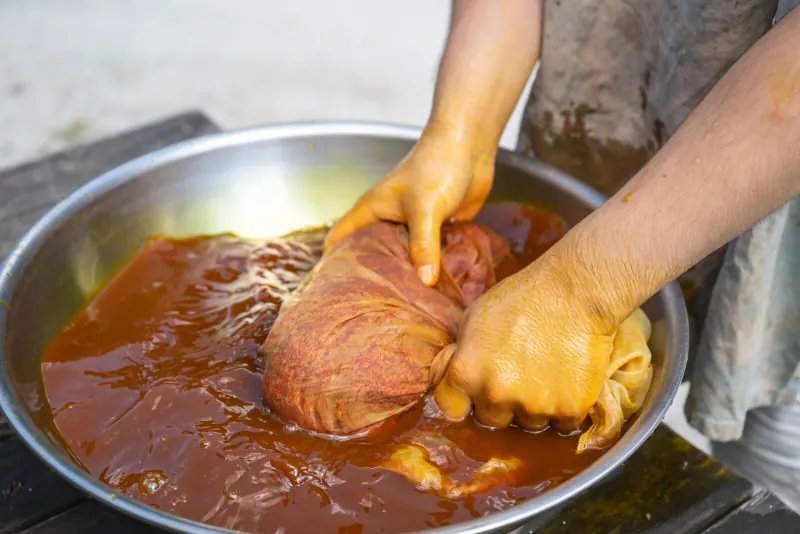
The mash is bagged and kneaded in clean water, the water renewed until it runs clear, stripping the water-soluble yellow
Step 3. Ferment in soured rice-water.
The bag is kneaded in fermented rice-rinse water (aged 7 to 10 days, 5 to 6 in deep winter); its microbes ferment the petal and pull out residual yellow, deepening the red
Step 4. Pack and ferment overnight.
The reddened petals are pressed into a jar and covered against air and insects with broad oak or paper-mulberry leaves topped with mugwort stalks, then fermented one night
Step 5. Shape.
The fermented mass, now distinctly redder, is formed into flat round cakes thin enough to dry quickly
Step 6. Dry.
The cakes are dried two to three days on Korean paper (한지) in ventilated shade
The documentation sets out five reasons the cake route is preferred for keeping colour across the year: the yellow is already gone, so red dyeing can be undertaken at any time; the fermentation step deepens the colour and improves its development in the bath; the fermented, dried cake stores far more securely than raw dried flower, which is prone to damp, pests and colour loss; laying up cakes in a good crop year hedges against price swings when material must later be bought; and the cake is light and compact, so it travels easily (Yun 2019, p. 39). Two further conservation forms extend the same logic of banking the pigment before or after dyeing: yeonji (연지), the red precipitated to a concentrated paste, and the reservoir cloth gaeogi (8.2), which stores leftover dye in already-dyed cloth (Yun 2019, pp. 46, 52-53, 108).
| Route A: dried whole floret | Route B: fermented cake (홍떡) | |
|---|---|---|
| Form stored | whole dried florets in a glazed jar | fermented, dried pigment cakes |
| Yellow removed? | no; leached fresh at each dyeing | yes; removed before storage |
| Fermented? | no | yes (soured rice-water) |
| Colour result | standard | finer and deeper |
| Storage / transport | bulkier; more pest- and damp-sensitive | compact, light, keeps well |
| Labour at dyeing | high (full yellow-strip each time) | lower (yellow already gone) |
4. PREPARATION OF THE FIBRE: SCOURING AND BLEACHING
Before any colour is applied, the goods are scoured and bleached, the first operation the holder learned as an apprentice (Yun 2019, p. 60). Scouring (jeongnyeon, 정련) removes impurities so that dye penetrates evenly and does not blotch; bleaching (pyobaek, 표백) lifts the natural yellowness to a white that lets the red read clearly. For silk the essential task is the removal of sericin (세리신 / 견교, silk glue), the protein coating of the raw filament: undegummed silk absorbs unevenly and blotches, so the goods are briefly boiled in lye to dissolve it out. The material is then washed until the water runs clear, wrung, and dried in a ventilated place. Cloth and skeined thread are both prepared this way (Yun 2019, pp. 60-61).
5. THE REAGENT SYSTEM: ALKALI AND ACID
5.1 The alkali - plant-ash lye (잿물)
The red pigment is insoluble except in alkali, which is supplied as lye leached from plant ash. Ash from bean stalks (콩대) is held to give the best lye and the cleanest extraction; bean pods, safflower stalk, goosefoot, oak and others also serve, and stalks aged one year are preferred (Yun 2019, pp. 66-67). The stalks are burned and the embers quenched with a little water exactly as the last flame dies, then moved to a perforated steaming vessel (siru, 시루) and leached with warm water at about 45 °C. The holder judges strength by the slight slipperiness of the liquor between his fingers, teaching students a working target of roughly pH 11 (Yun 2019, p. 80).
| Quantity | Value | Note |
|---|---|---|
| Lye yield of ash | ~5 L per 1 kg | well-burned bean-stalk ash |
| Lye per single dyeing of one bolt | ~6 L | one 필 (pil), one immersion |
| Standing batch | ~10 kg → ~50 L | sufficient for ~20 dyeings |
| Leaching-water temperature | ~45 °C | warm water through the ash |
| Target concentration | ~pH 11 | judged by slippery feel |
5.2 The acid – omija vinegar (오미자초)
The acid that develops and fixes the colour is a fermented vinegar of the schisandra berry, omija (오미자 五味子). The holder identifies this as the signature of Korean safflower dyeing, distinguishing it from the plum vinegar (오매 / 매실초) used for the same purpose in China and Japan (Yun 2019, p. 70). It is prepared roughly two weeks before dyeing at about a 1:1 ratio of water to berry; acidity is best between the tenth and fourteenth day, after which the flesh breaks down and produces a sediment that will blotch the goods, so the liquor is strained two or three times before use (Yun 2019, pp. 70, 72). Beyond its acidity it acts as the colour-developing agent, neutralising the alkaline red liquor so that the pigment comes out of solution onto the fibre.
6. EXTRACTION OF THE RED LIQUOR (홍염수)
The dye liquor proper, hongyeomsu (紅染水), is what remains after the yellow has been discarded and the red taken up into alkali. It is prepared in two moves (Yun 2019, pp. 74-77):
Step 1. Strip the yellow.
Dried florets are loosely bagged, steeped in water for about two days, then kneaded so the water-soluble yellow bleeds out; the water is scooped and inspected and renewed until it runs pale, and the bag is finally pressed to expel the last yellow-charged water. Kneading is kept gentle so the petals are not shredded.
Step 2. Draw the red into lye.
Cold plant-ash lye is poured over the de-yellowed red petals in the bag and worked through them; the alkali dissolves the red, and the resulting liquor is collected and held below 40 °C to protect the pigment.
7. DYEING THE DEEP RED (대홍염색)
7.1 Assembling the bath and the "flower foam"
The bath is made by blending the red liquor with omija vinegar at approximately 3:1 (for example 6 L of liquor to 2 L of vinegar). On contact the two react and a pink froth, the kkot-geopum (꽃거품, "flower foam"), rises to the surface: this foam is the precipitating pigment itself, and it is what colours the cloth. The 3:1 figure is nominal only; because neither the strength of a given lye nor that of a given vinegar can be measured exactly, the true ratio is corrected by experience for each batch, and treating 3:1 as fixed is named as a common source of error (Yun 2019, pp. 80-81).
7.2 The immersion sequence
Step 1. First dip.
The scoured cloth is drawn swiftly into the foam, submerged and turned so it takes colour evenly, then folded fan-wise for the next dip. Protein fibre (silk) is dyed first and cellulosic fibre (cotton, ramie) after, since the plant fibres take up the red quickly; speed of handling is the single most important guard against blotching. Spent liquor is reserved.
Step 2. Repeat, re-blending each cycle.
The liquor is re-mixed so fresh foam rises and the goods are dipped again. Colour climbs through pink and rose toward deep red with each repetition.
Step 3. Build to daehong.
True deep red requires on the order of thirty or more immersions; the holder cites thirty-three or more as his own practice. Concentration and cycle count trade off: doubling the strength of the liquor and vinegar roughly halves the number of dips, a shortcut used in the humid summer when repeated drying is difficult (Yun 2019, pp. 79, 81).
Step 4. After-treatment for fastness.
From about the fifth cycle the goods are rinsed in raw-soybean-flour water (날콩가루 물), or rice-bran water where soybean is lacking. This leaves a proteinaceous coating that raises lightfastness and slows the fading of the red (Yun 2019, pp. 84-85).
Step 5. Dry between later dips.
From roughly the sixth cycle the cloth is dried before being re-entered, because dry fibre draws up more dye than wet; it is spread wide in a ventilated shade so that no blotch sets (Yun 2019, p. 85).
7.3 Historical material accounts
The scale of the operation is preserved in the Joseon court manual Sangbangjeongnye (尙房定例, 1750), which records the charge of materials per unit of daehong-dyed goods. The figures below are as recorded there and cited in the documentation; note that the acid appears as plum (매실), the Chinese-derived reagent that Korean practice replaces with omija vinegar (Yun 2019, p. 78).
| Goods | Safflower | Ash (lye) | Plum (acid) |
|---|---|---|---|
| Deep-red 숙초, 1 bolt (crown-prince use) | 17 geun | – | 13 geun |
| Deep-red 숙초, 2 bolts (강사포) | 23 geun | – | 26 geun |
| Deep-red 토주 (per bolt) | 12 geun | 4 du | 12 geun |
| Deep-red 사 (per geun) | 13 geun | 4 mal | 10 geun |
| Deep-red cotton (per bolt) | 9 geun | 3 mal | 8 geun |
The court's annual requirement is given as about 150 geun of safflower, apportioned to the northern provinces whose crop was judged finest (Yun 2019, p. 79).
8. VARIANTS: YARN DYEING AND RESERVOIR DYEING
8.1 Yarn / thread dyeing (실염색)
Thread is dyed in the same bath but is more blotch-prone because the fibre is fine and tightly bundled. The skein is worked on a smooth stainless rod with a hook, shaken and crossed top to bottom so that the liquor reaches evenly through the bundle; the goods are wrung out with the tool between cycles and re-dipped until the target depth is reached (Yun 2019, pp. 100-101). Yarn-dyed (pre-woven) cloth is more costly than piece-dyed cloth precisely because of this greater material and skill demand.
8.2 Reservoir dyeing (개오기염색)
Nothing of the expensive pigment is wasted: leftover dye is banked by soaking it into cotton or ramie cloth, the gaeogi (개오기), which is then dried and stored. When needed, the pigment is re-leached from that cloth with lye at about 40 °C and omija vinegar and used to dye fresh goods a clean pink-red. Because the stored cloth holds only red (the yellow having already been removed) and needs no preservative, this is a rational, durable way to keep colour; the documentation relates it to the Chinese 연지면 (綿臙脂) tradition of pigment-charged cotton (Yun 2019, pp. 56-57, 108-109).
9. FINISHING: CALENDERING AND GLOSSING (도침)
The dyed cloth is finished by dochim (搗砧), a sizing-and-glossing operation. A dilute animal glue (아교풀) or starch is fed into the cloth and allowed to dry to near-dryness; the goods are then glossed, traditionally by fulling on a smoothing block or wrapping the cloth on a wooden roller and beating it, and in the holder's own method by spreading the cloth on a warm floor and rubbing it down by hand so that body heat and friction raise the sheen.
Beating while the cloth is still wet dulls the finish, so the work waits until the size has nearly set. The operation straightens the weave, settles the size between the fibres for a lasting gloss, and makes the accumulated red read deeper and more vivid; because it is entirely manual, the holder is assisted by his wife (Yun 2019, pp. 114-115). Colour-specific finishing recipes, including the sizes appropriate to reds, are recorded in the Gyuhap chongseo (閨閤叢書, 1809).
10. CONSOLIDATED PROCESS FLOW
| Phase | Operation | Key parameters |
|---|---|---|
| A. Raw material | Cultivate, harvest, dry, store safflower | spring sow / July pick; dawn hand-harvest; sun-dry ~7 days; jar dry in 오지독 |
| B(i). Preserve - route A | Store dried whole florets | simplest; yellow must be leached fresh at each dyeing |
| B(ii). Preserve - route B | Ferment and cake the pigment (홍떡) | pound → wash out yellow → ferment in soured rice-water 7-10 d → leaf-cover overnight → shape → dry 2-3 d; deeper colour, storable, portable |
| C. Fibre prep | Scour and bleach | boil in lye; remove sericin from silk; wash clear; dry |
| D. Reagents | Make lye; make omija vinegar | bean-stalk ash + 45 °C water → ~pH 11; vinegar ~1:1, peak 10-14 days |
| E. Dye liquor | Strip yellow; extract red into lye (홍염수) | soak ~2 d, knead yellow out; cold lye extraction; hold <40 °C |
| F. Dyeing | Blend bath; immerse; repeat | liquor:vinegar ~3:1; foam forms; silk before cellulose; ~30+ dips (holder 33+) |
| G. Fastness | Soybean-flour rinse; inter-dip drying | from ~5th cycle; coating for lightfastness; dry from ~6th cycle |
| H. Variants | Yarn dyeing; reservoir (개오기) | skein on rod + hook; bank leftover dye in cloth |
| I. Finishing | Size and gloss (도침) | glue/starch size; near-dry; full or hand-rub for sheen |
APPENDIX A. GLOSSARY OF TERMS
| Term (romanised) | Korean | Chinese (Hanja) | Gloss |
|---|---|---|---|
| hongyeom | 홍염 | 紅染 | red dyeing with safflower |
| hongyeomjang | 홍염장 | 紅染匠 | master of safflower red dyeing (the craft / holder) |
| daehong | 대홍 | 大紅 | the deepest red, the target grade |
| honghwa | 홍화 / 잇꽃 | 紅花 | safflower, Carthamus tinctorius |
| hongtteok | 홍떡 | 紅花餠 | fermented, dried pigment cake (preservation route B) |
| yeonji | 연지 | 臙脂 | precipitated safflower pigment; rouge and dye |
| gaeogi | 개오기 | — | reservoir cloth that banks leftover dye |
| jaetmul | 잿물 | — | plant-ash lye (the alkali) |
| omijacho | 오미자초 | 五味子醋 | schisandra-berry vinegar (the acid) |
| hongyeomsu | 홍염수 | 紅染水 | the extracted red dye liquor |
| kkot-geopum | 꽃거품 | — | "flower foam", the precipitating pigment in the bath |
| jeongnyeon | 정련 | 精練 | scouring / degumming of the fibre |
| pyobaek | 표백 | 漂白 | bleaching |
| sericin (gyeongyo) | 세리신 (견교) | 絹膠 | silk glue removed in degumming |
| dochim | 도침 | 搗砧 | calendering / glossing finish |
| oji-dok | 오지독 | — | glazed earthenware storage jar |
| siru | 시루 | — | perforated earthen vessel used to leach lye |
| pil / geun / du, mal | 필 / 근 / 두, 말 | 疋 / 斤 / 斗 | bolt of cloth; weight (~600 g); dry measures |
APPENDIX B. A NOTE ON THE MODERN CHEMISTRY
Interpretive Note from the Complier
In present-day terms the two pigment fractions of the source book correspond to the safflower yellows (water-soluble C-glycosyl quinochalcones, chiefly hydroxysafflor yellow A) and the single red, carthamin (a quinochalcone that is sparingly soluble and unstable to alkali and light). The traditional sequence is a coherent chemistry: the yellows are simply washed out in water; carthamin is liberated from the petal under alkaline lye, in which it is soluble but heat-labile, so the liquor is kept cold; re-acidifying the alkaline extract with omija (or plum) vinegar drops the pH and throws carthamin out of solution as the visible "flower foam", which deposits on and bonds to the fibre. Carthamin's intrinsic fugitivity to light explains both the many repeated immersions needed to build daehong and the protective soybean-flour after-treatment. These identifications are supplied here for context and are the compiler's, not claims of the 2019 documentation.
References and sources
- Primary documentation. Yun Yang-no (윤양노, text) and Choi Ho-sik (최호식, photography). 홍염장 [Hongyeomjang], Seoul Metropolitan City Intangible Cultural Heritage No. 49. Seoul: Seoul Metropolitan Government, Culture Headquarters, History and Cultural Heritage Division, 2019. ISBN 979-11-6161-564-6. Seoul e-book
- Historical sources cited within the primary documentation. Bak Se-dang, Saekgyeong (穡經, 1676); Song Yingxing, Tiangong Kaiwu (天工開物, c. 1637); Bingheogak Yi, Gyuhap chongseo (閨閤叢書, 1809); Yi Gyu-gyeong, Oju yeonmun jangjeon sango (五洲衍文長箋散稿); Sangbangjeongnye (尙房定例, 1750). SaekgyeongTiangong KaiwuGyuhap chongseoOju yeonmun jangjeon sangoSangbangjeongnye
How to cite
Park, Haram Jackson. “The Production Sequence of Safflower Red (Hongyeom) Dyeing.” Dyeing the Dying History. https://dyeingthedyinghistory.com/red/process.