
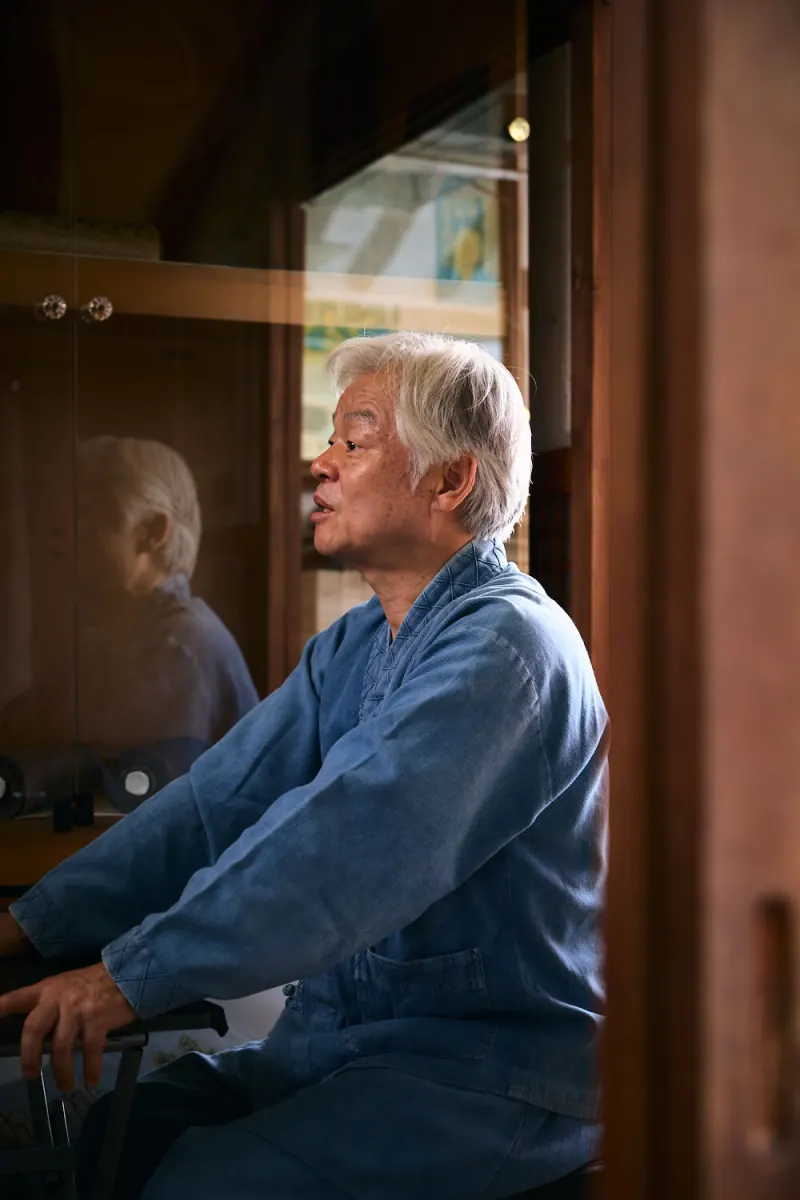
Abstract
This record documents the life, practice, and outlook of Kim Gyeong-yeol (김경열, b. 1959), holder of Hongyeomjang (홍염장, 紅染匠), Seoul Intangible Cultural Heritage No. 49. Hongyeom is the Joseon court craft of dyeing textiles red, principally with safflower (Carthamus tinctorius). Designated in April 2017, it was the first heritage recognition of red dyeing anywhere in Korea.
The account follows Kim from apprenticeship in his maternal family's silk-thread workshop, through five decades of cultivation, restoration, and research, to his present work in transmission and advocacy. It gives particular attention to his mindset: the disciplines of self-preparation, material care, and fidelity to promises that he treats as inseparable from technique.
I. 장인정신 (Jangin Jeongsin): The Attitude of the Master
On the day before he dyes, Kim Gyeong-yeol does not dye. He travels to his country house in Danyang, in the hills of North Chungcheong Province, and stays the night. The purpose, in his words, is to empty the body and set the mind right.
Only then does he stand before the undyed cloth. He speaks of that white cloth with something close to reverence. It is the ground of every piece he has made, and in restoration it is the material on which a centuries-old artifact will either be recovered or lost.
The habit is a useful point of entry. For Kim, dyeing is not only a technique applied to a material. It is a discipline applied first to oneself, and the preparation of the dyer is treated as part of the process, alongside the preparation of the cloth and the dye liquor.
II. The vow: origins and apprenticeship
Kim was born in 1959 in Osan, Gyeonggi Province. In 1974, at sixteen by Korean reckoning, he entered his maternal uncle's silk-thread workshop in Seoul after his family fell on hard times. He dates his life in hongyeom from that year:
홍염 인생이 그때 이미 시작됐어요.
My hongyeom life had already begun then.
The workshop had been run by his maternal grandfather and passed to his uncle. There he learned through apprenticeship the composition of fibers and the preparatory stages of unwinding (haesa, 解絲), scouring, bleaching, and thread-twisting on which all dyeing depends. This lineage is the formal basis of his standing as a transmitter rather than a revivalist.
In high school he made a decision about the shape of his life. He resolved to live as a gisulin (기술인), a person of skill. At the same time he promised himself never to drink or smoke, and he has kept that promise for half a century.
People close to him mention this trait first. A promise, once made, is not revisited. The steadiness that governs his personal conduct also governs his craft, and it helps explain how he remained at the dye vat through decades when there was little money or recognition in the work.
III. Building the foundation
After military service, Kim opened his own silk workshop in Myeonmok-dong, Jungnang-gu, Seoul, in 1982. Traditional dyeing did not sustain itself financially. He funded his research through other work, notably the production of textbooks.
His use of that income is revealing. Where others might have bought land or buildings, Kim bought cloth. Each time savings accumulated, he spent them on fabric. Many of those textiles are no longer manufactured, and the collection is now valued less for its price than for its rarity. In effect, he invested in the material future of the craft rather than in personal security.
He also sought teachers. Buddhist monks shaped his understanding of the robes he would restore. Professor Kim In-sook of Ewha Womans University suggested he reproduce gasa, the red robes of Buddhist monks, a project that occupied him for nearly two decades.
Kim repeatedly credits Kim In-sook, Kim Ji-hee of Hyosung Women's University, and Kim Young-sook, a former cultural heritage specialist. He has said he fears appearing to have succeeded alone.
His wife, Lee Hyung-sook, a hanbok maker, has worked beside him throughout. The armors and robes he reproduced depended on her sewing and embroidery, and he acknowledges this directly. The workshop, in this sense, has always been a household enterprise.
IV. In search of the right land
Kim holds that the dye is decided by the water, and the flower by the land. Safflower is sensitive to temperature and humidity, and the quality of its red depends on where it grows.
So he went looking. He left Seoul for Bundang, then Suwon. Neither satisfied him, and each time he moved farther away. He read the land as earlier generations had, through the geomancy of mountains and water, and he read the historical record for places where the finest safflower had grown.
The search ended in Danyang. In 1989 he began cultivating safflower there on about 7,000 pyeong (roughly 23,000 m²), at 200 to 300 meters altitude, where daily temperatures swing widely. A seed scientist's remark that a natural dyer must know his materials had set him on this path.
The move was also a moral decision. Kim has said that city life might weaken his commitment to traditional method, and that artisans today should live a traditional life so their attitudes match those of their predecessors. Agriculture, place, and conduct are, for him, one question.
The chemistry of red
Safflower is sown in late March or early April; petals are harvested in late June. The petals hold both yellow and red pigment. The dyer washes out the yellow in water, extracts the red with alkaline lye made from the ash of safflower stalks and glutinous rice straw, then neutralizes the liquor with omija (Schisandra) or plum vinegar to develop the color.
홍화는 알칼리성 잿물에 넣어야 홍색을 뺄 수 있습니다.
Only in alkaline lye can the red be drawn out of safflower.
The work must stay below about 40°C, since the pigment is organic and unstable. Each immersion deepens the shade, from pale pink toward daehong (大紅), the deepest red. Daehong requires at least eight repetitions. A king's robe may take more than thirty, and Kim's deepest daehong close to thirty-three. Eight is the minimum that defines the color; the higher counts are the depth he pursues in practice.
Red is not one color. Kim distinguishes more than thirty named reds, among them yeonhong, suhong, dahong, juhong, jinhong, cheonhong, and mokhong, because each dyestuff produces its own tendency. In his account the sequence runs: pound the petals into hongtteok, wash out the yellow in soft water, draw out the red with bean-stalk lye, then add omija or plum vinegar. Temperature, the state of the liquor, and the count of repetitions are judged by hand and eye alone.
This is why he farms.
저는 반은 농사꾼이에요.
I am half a farmer.
He sows in March or April and harvests in June or July, controlling the material from seed onward.
Kim also commands older storage techniques. Hongtteok are cakes of safflower petals fermented in rice-rinsing water and dried for year-round use. In gaeogi dyeing, the red is first fixed onto cotton, then re-extracted with lye when needed. He has the rare skill of cinnabar dyeing as well, used for Joseon armor.
The historical office
In the Joseon court, this knowledge belonged to specialists. Ten hongyeomjang served the Sangeuiwon (尙衣院), which made royal dress, and ten the Jeyonggam (濟用監), which managed court textiles. Red official robes were restricted to the crown prince and officials of dangsanggwan rank and above. Kim understands himself as heir to that office.
V. A fingertip between life and death: restoration
Restoration is the work Kim finds most demanding. There is no machine to share the responsibility: a single movement of the hand decides whether an artifact lives or dies. His response to that pressure is the same attitude he brings to the white cloth, a deliberate care for each material, thread, and measure of liquor.
His method, visible across the cases below, is consistent. He begins from what the object still holds, reasons back to its original state, and lets color be fixed by evidence and expert consultation rather than taste.
Armor of General Yi Bong-sang
Yi Bong-sang, a fifth-generation descendant of Admiral Yi Sun-sin, was a high commander of Joseon. His red armor survived only in fragments. Kim spent a year on its reproduction, completing it in 2006; it won the Presidential Prize at the 33rd Korea Traditional Crafts Exhibition in 2008. He has described red armor as both beautiful and functional, its color signifying dignity and a prayer for safe return.
Buddhist robes
Over nearly twenty years Kim reproduced gasa one by one, including the kasaya of National Preceptor Daegak at Seonamsa Temple, Suncheon, and exhibited them together in 2007. Asked which work stays with him most, he named a Tibetan kasaya, because it displayed dyeing culture so fully.
Court dress and furnishings
Kim has reproduced the hongryongpo, the red dragon robe worn by the Joseon crown prince as daily and working dress from 1444, in both cloud-and-treasure satin and cloud-patterned gauze. He has also reproduced the hongwonsam, the queen's red ceremonial robe, and the embroidered cushions of Princess Bogon and of the queen, whose central squares are safflower red and whose borders combine indigo, turmeric, and gardenia. Earlier work includes Empress Myeongseong's ten-panel screen.
Overseas collections
His restoration work extends to collections abroad. They include the kasaya of a Tibetan high monk held by the Cleveland Museum of Art in the United States, and artifacts at a municipal museum in Japan, most likely the Sakai City Museum.
Uigwe covers
The uigwe are illustrated records of Joseon royal ceremony. Kim restored the cloth covers of the Oegyujanggak Uigwe returned from France, extracting surviving color and dyeing repeatedly to match it. He described the burden as heavy and the work as moving: to touch the traces of ancestors two centuries gone.
Between 2010 and 2012 he also restored the cover textiles of national-treasure-class records, including volumes of the Annals of the Joseon Dynasty (Joseon Wangjo Sillok) and uigwe.
He has also restored uigwe covers held by Seoul National University's Kyujanggak and the National Palace Museum:
| Volume | Ground fabric | Dyes | Approach |
|---|---|---|---|
| Chogye Munsin Jemyeongnok | Silk damask | Indigo | Faded grey outside, indigo intact inside; matched by repeated dipping in fermented indigo, finished with soybean liquid and starch |
| Boinso Uigwe | Raw silk | Indigo, turmeric, gardenia | Indigo to depth, lye removed, adjusted with turmeric and gardenia against textile color references |
| Hwagi Dogam Uigwe | Cotton | Sappanwood | Original judged not dark; repeated dyeing to a middle tone agreed by the review committee |
| Daesarye Uigwe | Hemp | Sappanwood, safflower, omija | Sappanwood ground, safflower and omija for red, sappanwood again for a deep red; repeated for fastness |
The table shows restoration as inference under constraint. Each fabric, each surviving trace, and each committee judgment produces a different path to the same end.
VI. Recognition
Formal recognition came late and cumulatively, through decades of work rather than a single achievement.
In 2010 Kim completed a master's degree in cultural heritage at Dongguk University's Graduate School of Culture and Arts. His thesis, A Study of Traditional Korean Safflower Dyeing (韓國 傳統 紅花染色 硏究), reflected his conviction that dyeing needed a scientific footing. That year he also received the grand prize of the Society of Asian Ethno-Forms.
In 2013 he was named Korea Master Craftsman (대한민국명장) No. 561 in textile processing.
On 13 April 2017, the Seoul Metropolitan Government designated Hongyeomjang as Seoul Intangible Cultural Heritage No. 49 and recognized Kim as its holder. It was the first time red dyeing was designated as heritage in Korea. Seoul linked the designation to its identity as seat of the Joseon court: this was the court's color, and Kim's restorations made him its living carrier.
Asked what the title meant, Kim answered:
장인은 어떤 명예를 얻었다고 끝나는 게 아니고 꾸준히 생산해내는 사람이 돼야 한다.
A master is not finished when he receives an honor; he must keep producing.
A master, in his view, should do as much work as he can while alive.
In 2019 the city documented the craft in Hongyeomjang, Seoul Intangible Cultural Heritage No. 49, written by Yoon Yang-no. The volume is now out of print.
VII. Joseon red in the present
Kim does not treat hongyeom as a museum piece. He has tested it beyond textiles, applying the dye repeatedly to wooden chairs to study how a natural colorant interacts with timber, structure, and ornament. He concluded that the dye's properties sat in harmony with the wood.
The chairs were shown at the Wooran Foundation lobby, Seoul (23 June to 6 July 2022), and in Les Neuf Chaises, a Korean-French design collaboration at the Alliance Française Busan Art Space (12 to 30 November 2022).
He has also taken the work abroad and into scholarly networks:
| Dates | Exhibition | Venue |
|---|---|---|
| 23 to 28 April 2025 | A Beautiful Invitation to Vanishing Folk Art, Society of Asian Ethno-Forms members' exhibition | Maru Art Center, Insadong, Seoul |
| Dec 2024 to 2025 | East Asia International Exhibition in Tokyo | Tokyo |
| 21 to 23 February 2024 | East Asia International Exhibition in Okinawa | Okinawa Craft Forest |
| November 2025 | Joint exhibition of Seoul intangible heritage holders | Insa Art Center, Seoul |
Kim has served as the 12th and 13th president of the Society of Asian Ethno-Forms (아시아민족조형학회), which joins practitioners and costume historians. He also judges the top master craftsman selections in Gyeongbuk, Jeju, and Busan. As early as 2018 he spoke of branding hongyeom for daily life, imagining a daehong necktie as a small modern object carrying the king's color forward. He frames this not as commercialization:
전통이 전통으로 끝나지 않도록 기초를 다지고 있다.
I am laying foundations so that tradition does not end as mere tradition.
VIII. Transmission
Kim teaches on two tracks, both organized by quarterly curriculum.
The first is open to the public, held at the transmission education center near Donhwamun in Jongno, Seoul. Participants dye with their own hands through repeated practice. The second is an advanced course for Seoul's heritage scholarship students, covering the finer stages of dyeing, color combination, and handling of materials. In autumn 2025, for example, he taught a twelve-week Friday course at the Seoul Intangible Heritage Education Center.
In both, his emphasis is the same. Students are to understand not only how to dye but what dyeing means: the traditional values that surface in the process and the significance of the craft as intangible heritage. Technique without that understanding, in his framing, is not transmission.
His workshop in Bukchon Hanok Village, opened in November 2017 near the palaces, receives Korean and foreign visitors. All three of his children, his eldest daughter among them, have shown interest in hongyeom, and he hopes it will continue as a family trade. The lineage that began in his grandfather's workshop may thus return to a family form.
IX. The cultural general
Kim describes himself as a munhwajeok janggun (문화적 장군), a cultural general. The phrase is not a boast. It names a role: someone charged with holding ground that would otherwise be lost.
His aims are specific. He wants hongyeom recognized by UNESCO. He wants it known in both East and West. And he wants the history of Korean red dyeing established accurately and on its own terms, so that it is no longer conflated with the safflower traditions of China or Japan. The symposium at which he presented his paper on 22 October 2025 was itself convened to launch a UNESCO nomination for Korean hanbok culture, which places his craft inside a larger national effort.
He is equally clear about why crafts like his are disappearing. The problem, in his analysis, is not a lack of skill or interest but the absence of any revenue structure that lets the work sustain those who do it.
The succession problem is felt, not abstract. At a recent lunch with other intangible heritage holders and transmitters, all of them elderly, Kim voiced what the table shared in silence:
우리 같은 사람들이 다 늙어가는데, 뒤를 이을 사람이 없다고.
People like us are all growing old, and there is no one to follow.
He is the only person in Korea still reproducing daehong by hand.
His proposed answer is a Hongyeom Village: a place where people drawn to red dyeing and to dyeing culture can experience the whole process, from field to vat, and carry the tradition forward together with one mind. The idea joins his two lifelong commitments, to the land where the flower grows and to the people who will inherit the craft.
X. Conclusion: return to the white cloth
Across five decades, the constants in Kim Gyeong-yeol's life are few and steady. A promise kept. A flower followed across the country to the land that suited it. A reverence for material, expressed in cloth bought instead of property and in the care taken over each thread. And a sense that the red of the Joseon court is a trust held on behalf of others, not a possession.
What his case adds to the record of Korean intangible heritage is a clear demonstration that technique and disposition are transmitted together. The chemistry of safflower can be written down. The discipline of the night in Danyang, the refusal to break a vow, and the fear of being thought to have succeeded alone are harder to document, and more easily lost.
Each dyeing still begins where it always has: with the master alone before an undyed cloth, having first made himself ready to touch it.
Appendix A: Chronology
| Year | Event |
|---|---|
| 2025 | Symposium paper at the 2030 Hanbok Life UNESCO nomination launch; Insadong exhibition; Seoul holders' joint exhibition |
| 2024 | East Asia International Exhibitions, Okinawa and Tokyo |
| 2022 | Hongyeom chair works at Wooran Foundation and Les Neuf Chaises, Busan |
| 2019 | Hongyeomjang documentation volume published by Seoul |
| 2017 | Holder, Seoul Intangible Cultural Heritage No. 49 (13 April); Bukchon workshop opens (November) |
| 2013 | Korea Master Craftsman No. 561, textile processing |
| 2010 | MA, Dongguk University; grand prize, Society of Asian Ethno-Forms |
| 2008 | Presidential Prize, 33rd Korea Traditional Crafts Exhibition |
| 2007 | Exhibition of reproduced Buddhist robes |
| 2006 | Completes reproduction of General Yi Bong-sang's armor |
| 1989 | Begins safflower cultivation in Danyang, after Bundang and Suwon |
| 1982 | Opens own silk workshop, Myeonmok-dong, Seoul |
| 1974 | Enters maternal family's silk-thread workshop |
| 1959 | Born in Osan, Gyeonggi Province |
References
Primary
- Kim Gyeong-yeol (2010). 韓國 傳統 紅花染色 硏究[A Study of Traditional Korean Safflower Dyeing]. MA thesis, Dongguk University, Seoul.
- Kim Gyeong-yeol (2025). 주제발표 2 [Keynote 2]. In 한복생활에 내재된 전통기술과 장인정신: 한복생활 유네스코 인류무형유산 등재추진단 발대식 및 제2차 학술 심포지엄, 22 October 2025, pp. 56 to 64.
- Yoon Yang-no (2019). 홍염장, 서울특별시 무형문화재 제49호. Seoul: Seoul Metropolitan Government.
- Field conversations between the author and Kim Gyeong-yeol (28 March, 15 July, and 19 September 2026; notes recorded from memory).
Official
- Seoul Metropolitan Government (2017). Designation of Hongyeomjang, Seoul Intangible Cultural Heritage No. 49. As reported in Maeil Ilbo, 13 April 2017 (m-i.kr/news/articleView.html?idxno=303623) and Seoul Wire, 22 April 2017 (the-biz.co.kr/news/articleView.html?idxno=419).
- National Heritage Service. 서울특별시 무형유산 홍염장. National Heritage Portal (heritage.go.kr).
Press and profiles
- Chung Ah-young (2015). "Dyeing with safflowers." The Korea Times, 17 May. koreatimes.co.kr/lifestyle/koreanheritage/20150517/dyeing-with-safflowers
- Seoul& (2017). "천연 염색 40년, 세계 최고의 홍색 뽑아내다." May. seouland.com/arti/society/society_general/1907.html
- Sisa Journal (2018). "김경열 명장 '조선 왕의 색 대홍, 손끝으로 뽑아낸다'." January. sisajournal.com/news/articleView.html?idxno=173383
- HRD Korea (2018). "손끝 기술로 익힌 홍염, 조선의 역사를 지키다." 5 March. webzine.hrdkorea.or.kr/section/webzine/view?id=6377
- Seoul Culture Today (2025). Seoul intangible heritage holders' joint exhibition. November. sctoday.co.kr/news/articleView.html?idxno=46491
- THE BC (2026). "붉은 실의 인연, 세계에 닿다: 하버드까지 퍼진 김경열의 대홍색." THE BC STORY, BC Card, September. Editor Lee Ye-na; photographer Bang Seok-hyeon. cdn.paybooc.co.kr/static/html/web/thebc/D1800PG002W.html?code=260901
Audiovisual
- Seoul Museum of Craft Art (2020). Hands: Kim Gyeong-yeol. youtube.com/watch?v=l9gtQg_mAzs
- 5분다큐 사람, ep. 41 (2017). 붉은 염색의 대가 홍염장. youtube.com/watch?v=MCjjKtf9PJ0
- YTN. 조선 시대 색채예술의 장인을 만나다. dailymotion.com/video/x69efpa
- Seoul Metropolitan Government (2019). 2018 Seoul intangible heritage documentation video. news.seoul.go.kr/culture/?p=501959
How to cite
Park, Haram Jackson. “Kim Gyeong-yeol and the Living Lineage of Hongyeom.” Dyeing the Dying History. https://dyeingthedyinghistory.com/red/kim-gyeong-yeol.