
Introduction
This record documents the traditional fermentation method of indigo dyeing as practiced in Saetgol, Dasi-myeon, Naju, on the Yeongsan River. It follows the practice of Jeong Gwan-chae, holder of National Intangible Cultural Heritage No. 115 Yeomsaekjang (염색장), alongside the fresh-leaf method of the Joseon period.
The Naju method has two phases. In the summer, the colour is taken out of the living plant and stored as a paste called niram (니람, 泥藍, "indigo mud"). Later, the paste is brought back to life in a fermenting vat of wood-ash lye, and cloth is dyed in it. The whole cycle runs from spring sowing to autumn dyeing and depends on three materials the dyer makes by hand: shell lime, ash lye, and the indigo itself.
Why indigo needs fermentation
Indigo is unlike most natural dyes. The green leaf holds no blue: it holds a colourless compound, indican. Soaked in water, indican breaks down to indoxyl, which turns blue (indigo) when it meets air. But indigo does not dissolve in water, so it cannot enter a fibre. To dye with it, the dyer must convert it back into a soluble, yellow-green form by reduction, carried out in Naju by microbes in an alkaline vat. The cloth absorbs the dye in this reduced form, and turns blue only when lifted into the air.
| Form | Colour | In water | Where it occurs |
|---|---|---|---|
| Indican | Colourless | Soluble | Living leaf |
| Indoxyl | Colourless to pale | Soluble | Steeping liquor |
| Indigo | Blue | Insoluble | Niram, dyed cloth |
| Reduced indigo (leuco-indigo) | Yellow-green | Soluble | Fermented vat |
The process at a glance
| Stage | Season | Duration | Result |
|---|---|---|---|
| 1. Growing and harvesting | April to September | 60 to 80 days to first cut | Fresh indigo plants |
| 2. Making shell lime | Before harvest | About 30 hours firing, 15 to 20 days slaking | Slaked lime (소석회) |
| 3. Steeping | July to September | 40 to 50 hours | Yellow-green liquor |
| 4. Oxidizing and settling | Same day | 1 to 3 hours settling, half a day to clear | Indigo paste (니람) |
| 5. Making lye | Any time | One day | Ash lye (잿물) |
| 6. Raising the vat | Late spring to early autumn, or heated indoors | 15 to 30 days | Living dye bath (꽃물) |
| 7. Preparing the cloth | Before dyeing | One to two days | Scoured cloth |
| 8. Dyeing | Whenever the vat is ready | 7 to 20 dips | Blue cloth |
| 9. Removing the lye | After dyeing | About three days | Finished cloth |
Materials and tools
| Item | Korean | Use |
|---|---|---|
| Indigo (Persicaria tinctoria) | 쪽, 쪽풀 | Source of the colour |
| Oyster or cockle shells | 굴껍데기, 꼬막껍데기 | Fired to make lime |
| Firewood | 장작 | Fuel for firing shells |
| Soybean stalks, indigo stalks | 콩대, 쪽대 | Burned for lye |
| Rice straw | 짚풀 | Filter bed for lye |
| Earthenware jars or tubs | 항아리, 독, 고무통 | Steeping, settling, fermentation |
| Heavy stones | 돌 | Holding plants under water |
| Wooden paddle | 고무래, 당그래 | Beating and stirring |
| Gourd dipper | 바가지 | Mixing lime, removing water |
| Steamer basket, sieve | 시루, 소쿠리, 체 | Straining, draining, lye |
| Cotton cloth | 무명천 | Lining for draining niram |
| Makgeolli, soju, malt, glucose | 막걸리, 소주, 엿기름, 포도당 | Food for the vat's microbes |
| Cloth to be dyed | 명주, 무명, 모시, 삼베 | Silk, cotton, ramie, hemp |
| pH meter (modern) | pH 측정기 | Checking the vat |
Stage 1. Growing and harvesting the indigo
Purpose: to grow leaves with the highest possible content of indican, and to get them into water before it is lost.
Preparing the field
- Plough the field early, working in well-rotted compost (9 to 10 kg per 10 m²) with lime and compound fertilizer.
- Form beds 90 to 120 cm wide with furrows of 30 to 40 cm, so that plants can be tended and cut by hand or machine.
- Indigo is a heavy feeder. Lay down compost in November or December of the previous year, and top-dress after each harvest.
Sowing and transplanting
- Sow in a seedbed or cell trays. Seed stored cool from the previous autumn germinates at over 80%.
- In Naju, transplant the first seedlings in early to mid May and the second in early to mid June, when they are 15 to 20 cm tall.
- Water the seedbed before lifting, so soil clings to the roots. Set plants 10 to 15 cm deep, 5 to 6 per clump, clumps 30 to 40 cm apart in rows 50 to 70 cm apart.
- Shade the young plants for the first hour and keep them well watered until they root, about a week.
Growing
- Keep the soil moist. Indigo tolerates standing water but wilts quickly when dry.
- Weed thoroughly in early summer, when indigo and summer weeds compete for light. Weeds left in the field end up in the dye.
- Watch for moth larvae and grasshoppers in late summer.
Harvesting
- When: cut before the flower spikes appear, when the pigment is at its peak. The first cut in Naju is usually 60 to 80 days after transplanting, in late June to mid July, when the plant stands 70 to 90 cm.
- How often: in the south, up to three cuts a year, roughly early July, mid-August and early September. Two cuts give the best quality; after that, the plant can be left to flower for seed.
- Time of day: Naju farmers cut at dawn or on cloudy days. Heat and bruising let indican convert and oxidize in the leaf, and the colour is lost before it reaches the jar.
- Height: cut 5 to 10 cm above the ground so the plant branches and regrows.
- Speed: move the cut plants to the steeping jars at once. A delay of even a few hours reduces the yield.
In Naju, 3.3 m² yielded about 15.5 kg of plant at the first cut and 12.3 kg at the second; leaves alone were 7.2 kg and 5.75 kg.
Stage 2. Making shell lime
Purpose: to make the slaked lime (소석회) that will draw the indigo out of the steeping liquor and make it settle.
In the past, dyers bought lime from kilns that fired it from oyster shell, or burned their own. Mineral lime and cockle-shell lime are sold today, but oyster-shell lime is still preferred.
- Build a fire in a kiln, or dig a pit and lay firewood across the bottom.
- Layer oyster, cockle or other shells over the wood, then more wood, repeating the layers.
- Fire the stack at over 800°C for about 30 hours; at the Jeong Gwan-chae centre, for two full days, until the shells are burned through.
- The fired shells keep their shape. Shovel them into jars.
- Leave them 15 to 20 days. They absorb moisture from the air, slake and crumble to powder.
- Sieve the powder and store it dry and airtight until needed.
Yield: 100 kg of shell gives 60 to 70 kg of lime.
Stage 3. Steeping the leaves
Purpose: to draw the colourless indican out of the leaves into water, where it breaks down into indoxyl.
Setting up
- Steep near the field or near running water. The work is wet, messy and smells strongly. In the past, jars were set out along roads and stream banks; today Naju dyers often steep in the field itself.
- Traditional vessels were large earthenware jars with narrow mouths, low enough to lift stems in and out. Today a 600 L plastic tub is common.
- Fill tubs with water the day before harvest. The water warms in the sun, which speeds extraction, and filling is quick once the plants arrive. Water left standing too long, however, can start the batch rotting.
Scale
One 600 L tub takes about 80 kg of plants and 450 L of water. A 660 m² (200 pyeong) field yields about 3,100 kg at the first cut, enough to fill nearly 39 tubs with more than 17,000 L of water, so the harvest must be matched to the number of vessels available. The Jeong Gwan-chae centre now uses concrete steeping tanks beside the field.
Method
- Pack the harvested stems into the jar, stems and leaves together.
- Fill with water to cover completely. (Putting plants in first is easier; plants dropped onto water float.)
- Weigh the plants down with a heavy stone so none rise above the surface.
- Leave the lid open on sunny days to let the sun warm the water. Cover the jar on rainy days, with a lid that still lets air through; plastic sheeting makes the liquor rot.
- After about a day, turn the mass so the top plants go to the bottom. The middle of the jar warms fastest and extracts most.
Timing
On a hot summer day, steep about 40 hours; on a cloudy day, about 50. The exact time depends on weather, water, vessel, altitude and the quantity of plants.
Signs that it is ready
- The water turns yellow-green, and appears a clear jade green in sunlight.
- The leaves lose their green and turn yellowish.
- Some of the colour has already oxidized, giving the surface a blue tinge.
If it goes too long: sugars released from the indican feed other microbes, a foam rises, and the liquor ferments the wrong way. Naju dyers said the batch had "gone over the ash" (재가 넘었다). Yield falls and the colour is dull.
Removing the stems
- When about 90% of the colour appears to be out, lift the stems from the jar.
- Catch the liquor that drips off the stems and return it to the jar.
- Skim or sieve out leaf fragments and debris. Anything left in will end up in the niram and lower its quality.
Stage 4. Oxidizing and settling: making niram
Purpose: to turn the dissolved indoxyl into blue indigo, make it settle with lime, and collect it as a storable paste.
Adding lime
- For a 450 L tub, prepare about 900 g of oyster-shell lime. Adjust for the lime's age, the liquor's acidity and its colour content; this is a matter of experience.
- Scoop some liquor into a gourd dipper, dissolve the lime in it, and pour it back.
- Use slightly too little rather than too much. Excess lime spoils the quality of the indigo, and adding more afterwards can dull the colour.
Beating the liquor
- Beat the liquor hard with a wooden paddle (고무래, 당그래). A paddle without edges or "ears" avoids cracking the jar.
- The aim is air: every stroke brings indoxyl into contact with oxygen, which turns it to indigo, and the lime gathers the indigo as it forms.
- Large batches are now aerated with a submersible pump, its outlet held above the surface so the water splashes down.
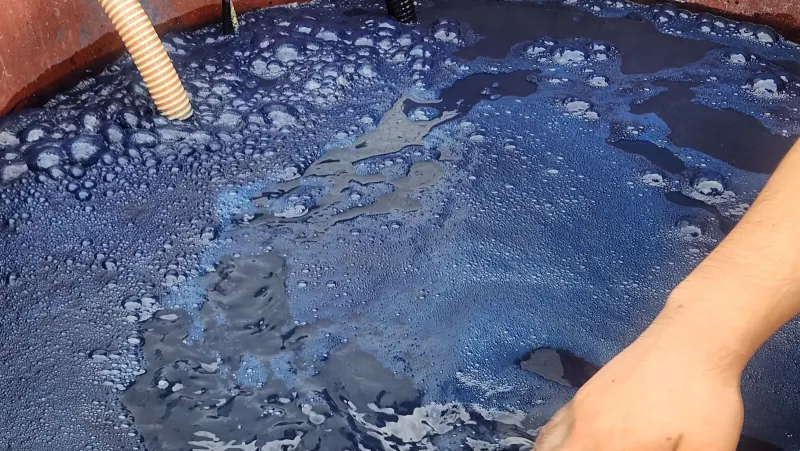
The colour sequence: as the liquor is beaten, it changes from yellow-brown to grey, purple, pale green, green, deep green, blue-green, bright blue and finally deep indigo, with a blue foam. The change from yellow to blue is the clearest sign of the whole process.
Settling
- Leave the tub still. The indigo begins to settle in 1 to 3 hours.
- After about half a day the upper water clears. Test it by drawing a little into a clear glass and holding it to the light: when no particles move, settling is complete.
- Tilt the jar gently, or dip off the clear water with a gourd, taking care not to lose the blue layer. The spent water can be used on the fields.
- A thick blue slurry remains at the bottom.
Draining and storing
- Line a basket or steamer with cotton cloth and pour in the slurry. The water drains away, leaving a dense blue paste: niram, which Saetgol dyers called "indigo lumps" (쪽물 덩어리). This step is called "striking the water" (물을 친다).
- Store niram cool. At room temperature it loses colour on contact with air; covered with plenty of water, it keeps longer. Use it as soon as practical.
On an industrial scale, the Naju centre loads about 60 tonnes of plants into a concrete tank, moves the liquor by gravity to an oxidation tank, adds about 2% (120 kg) of lime, and mixes for 30 minutes with a motor-driven screw.
Stage 5. Making lye
Purpose: to make the alkaline wood-ash water that dissolves the reduced indigo, keeps the vat from rotting, and supplies the sodium that helps fermentation.
The vat must stay between pH 10.0 and 11.5. Below 10 it rots; above 12, fermentation slows or stops. Traditionally, that alkalinity came entirely from lye (잿물), which is why Korean dyers say indigo and lye cannot be separated.
Choosing the ash
| Ash | Strength |
|---|---|
| Soybean stalk (콩대) | Strongest; richest in sodium; the Naju favourite |
| Indigo stalk (쪽대) | Moderate |
| Buckwheat stalk (메밀대) | Moderate |
| Goosefoot, sesame and pepper stalks | Used as available |
| Rice straw (볏짚) | Weakest |
Method one: dripping through ash
- Burn the stalks to ash and prepare a steamer basket (시루), a layer of rice straw and water.
- Set the basket over a jar and line it with damp straw.
- Fill the basket with ash.
- Pour boiling water over the ash.
- Pour the first, cloudy runoff back over the top.
- The clear water that seeps through the bottom of the basket is lye.
Method two: steeping and decanting
- Stir 1 kg of ash into 10 L of boiling water.
- When the ash settles, pour off the clear water. This is the first lye.
- Add another 10 L of boiling water to the same ash, stir, settle and decant again. Repeat up to three times; each draw is weaker.
Note: lye loses strength as it stands. Check its pH before use.
Stage 6. Raising the vat (물발 세우기)
Purpose: to turn insoluble niram back into soluble dye through fermentation. In Naju this is called mulbal seugi, "raising the water"; a vat that has succeeded is said to have "woken from sleep."
Strictly speaking, the vat does not ferment the indigo: bacteria in the vat produce enzymes that reduce it, removing oxygen and making it soluble. "Reduction" is the precise term, but "fermentation" is used to distinguish the living method from chemical reduction. One litre of a working vat contains around 400 million bacteria.
Setting up the vat
Vessel. An earthenware jar is traditional, and many dyers believe a "breathing" jar ferments better. In practice any vessel works; what matters is that its temperature stays steady. Choose a large vessel and fill it to the brim: a narrow surface lets less oxygen in. A 300 L jar filled only halfway can take 10 to 15 days longer to ferment.
Place. The bacteria work best around 30°C. Vats were set out in yards or under the eaves in summer and early autumn, and in winter were moved into heated rooms, storerooms, barns or kitchens.
Proportions. Korean dyers traditionally use about 10 parts lye to 2 parts niram. Too little niram gives a pale vat; too much cannot all be reduced, and the usable dye layer shrinks.
Method
- Break up the niram in a small vessel of lye until it is smooth, then add it to the jar. Repeat until all the paste is in.
- Measure the pH. It reads lower on the first day than the next, so allow for this. Aim for pH 10.0 to 11.5.
- Niram already contains a good deal of lime. Remove as much lime water as possible and set the pH with lye instead: too much lime alkali slows fermentation or stops it.
- When the liquid turns a pale green, add food for the bacteria: a little soju, makgeolli, malt, or glucose. A ladle of sediment from a working vat, added as a starter, speeds fermentation.
- Close the lid loosely. Oxygen hinders reduction, but a sealed vat does worse.
Tending the vat
- Stir gently once a day, even on days when no dyeing is done. Stirring mixes the settled pigment, spreads the additives, neutralizes the acid the bacteria produce, and evens out the temperature between the cool bottom and warm top. Over-stirring brings in oxygen and stops reduction. Use an oval paddle without edges.
- Keep the temperature near 30°C. Between 20 and 35°C there is little difference; below 20 or above 35 the bacteria struggle; below 10 they stop.
- Watch the pH. The vat becomes more acidic as it ferments. When it drops toward 10, add lye. If it climbs too high, add old makgeolli or vinegar. Near the end of fermentation, raise it toward 12 to dissolve the reduced indigo fully.
Dyers once judged the vat without instruments, by the tongue and the fingers: a strong vat was "salty" (짜다) and slick to the touch; a weak one "bland" (싱겁다).
Signs of a living vat
Fermentation usually takes 15 to 30 days; some vats have taken up to three years.
- When stirred, cabbage-green liquor billows up like cloud.
- Fine threads form in the liquid and loosen; this threading is the mulbal.
- Purple-blue foam forms on the surface, gathering like a flower. This finished bath is called kkotmul (꽃물), "flower water."
The vat room
The vat was treated with something close to ritual care. In Gahong-ri, Dasi-myeon, some families fermented indigo in a heated room that no one else could enter. While a vat was being raised, pregnant women, mourners and funeral guests, early-morning women visitors and people on bad terms with the household were kept away. Raising indigo was held to demand the same devotion as raising a child.
Stage 7. Preparing the cloth
Purpose: to scour the cloth so the dye takes evenly.
Indigo dyes both animal and plant fibres. In Korea it was used mainly on cotton (무명) and silk (명주), and also on ramie (모시) and hemp (삼베). Dye houses once dyed cloth themselves and sold it at market; from the late 1940s, customers more often brought their own cloth to be dyed.
- Make a batch of lye, usually from soybean-stalk ash.
- Soak the cloth in the lye to remove dirt, sizing and starch.
- Lift it out and rinse it. Repeat if the cloth is still stiff or dirty.
- Rinse thoroughly and hang to dry.
This scouring is called jeongryeon (정련). Poorly scoured cloth dyes unevenly, and any extra handling in the vat to force the dye in only lets air into the bath.
Stage 8. Dyeing
Purpose: to build the colour through repeated dips, letting air turn the absorbed dye blue each time.
When and where
- Season. Fresh-leaf dyeing is limited to the growing season. With stored niram, dyeing can happen whenever a vat can be raised. Small households dyed in summer and early autumn; larger dye houses made niram in summer and dyed through autumn and winter. With modern heating, dyeing can be done year round.
- Place. The fermented dye oxidizes as soon as it is ladled and moved, so traditionally the cloth was dyed in the fermenting jar itself. In winter, vats were raised and cloth dyed indoors. It is still best to dye close to the vat.
Method
- Stir the vat gently and let it settle. Dye when the vat shows its bloom: "when the indigo and the lye rise separately, like clouds."
- Lower the scoured cloth into the vat without splashing, keeping it below the surface.
- Open and turn the cloth gently so the dye reaches every part evenly. Avoid wringing or kneading: in other dyes this helps absorption, but here it drives air into the bath and oxidizes it.
- Leave the cloth in for about 20 minutes.
- Lift it out and let the excess drip back.
- Open it out in the air. It comes out yellow-green and turns green, then blue, within minutes as it meets oxygen.
- Dry it in sun and wind.
- Return it to the vat and repeat.
How many dips
Each dip deepens the colour. Practice has varied:
- Some dyers gave about 20 dips, the cloth at first blue, then darkening, and with more dips turning a dark, reddish black.
- Others dipped twice a day, drying the cloth each time, for 7 to 10 rounds, as long or as short as the dyer wished.
- Another Naju method was to leave the cloth in the jar overnight and wash it in the stream at dawn.
- At Master Jeong's workshop, a typical cloth receives about 8 dips; the deepest colour takes about 20.
Temperature
Indigo dyeing from a fermented vat is known as "cold-water dyeing" (찬물 염색). Most natural dyes are heated to open the fibre, but a heated indigo vat oxidizes and the colour turns muddy. The cloth is dyed at the vat's own working temperature.
The range of blues
With the number of dips and the strength of the vat, the same indigo runs from the palest jade (옥색) through sky blue (하늘색) and clear indigo blue (쪽빛, 청색) to deep blue (남색, 반물) and a near-black navy (감색, 아청). Overdyeing indigo with a yellow dye such as gardenia or pagoda-tree flower gives greens (초록, 유청, 두록).
Stage 9. Removing the lye and finishing
Purpose: to wash out the lime, loose pigment and alkali left in the cloth.
A well-fermented vat dyes cleanly. But where reduction was incomplete, lime and unfixed indigo stay in the fibre and will rub off onto skin and other clothes. Any alkali left in the cloth fades the colour and weakens the fibre over time. This final step, called jaenmul ppaegi (잿물빼기), matters as much as the dyeing.
Traditional methods
Traditional finishing used no chemicals. Dyers chose among:
- boiling the cloth once, then soaking it for a day and a night in a tub or jar of water;
- soaking at night and hanging it on the line by day, for about three days;
- leaving it in running water, then drying, and repeating.
Modern method
Today the dyed cloth is often soaked in a weak acid bath, such as vinegar, acetic acid or citric acid, which neutralizes the alkali quickly.
Finishing
- Rinse until the water runs clear.
- Hang the cloth in the open to dry. Long lengths of blue cloth drying on lines outside the Naju workshops are one of the images most associated with the craft.
- Properly fermented and finished indigo is prized for its fastness; the colour holds through washing and years of wear.
The other method: fresh-leaf dyeing
The fermentation vat is not the only way to dye with indigo. The oldest and simplest method uses fresh leaves directly, with no niram and no lye. It works only in summer, while the plant is growing, and gives lighter shades, mainly on silk.
In the Joseon period, dyers picked indigo leaves in the cool of the morning, ground them with ice on a stone, and dyed the cloth at once in the green juice. Thick leaves were picked in the sixth and seventh lunar months, and in the hottest part of summer the dye was kept beside ice.
Ice matters because heat oxidizes the juice before it can enter the fibre. At the Joseon court, fresh-leaf dyeing was common enough that "indigo ice" (남빙) was a standing item in the palace ice budget, and was among the first uses cut whenever ice ran short. Palace women dyed everyday garments this way, while the court's professional indigo dyers also made niram for use out of season.
Key parameters
| Stage | Parameter | Value |
|---|---|---|
| Harvest | Timing | Before flowering; 60 to 80 days after transplanting |
| Harvest | Plant height | 70 to 90 cm |
| Lime | Firing | Over 800°C, about 30 hours |
| Lime | Yield | 60 to 70 kg per 100 kg of shell |
| Steeping | Ratio | About 80 kg of plants to 450 L of water |
| Steeping | Time | About 40 hours (sunny), 50 hours (cloudy) |
| Oxidizing | Lime | About 900 g per 450 L of liquor |
| Settling | Time | 1 to 3 hours to settle; about half a day to clear |
| Lye | Ratio | 1 kg of ash to 10 L of boiling water |
| Vat | Lye to niram | About 10 : 2 |
| Vat | pH | 10.0 to 11.5 (up to 12 at the end) |
| Vat | Temperature | About 30°C (range 20 to 35°C) |
| Vat | Fermentation time | 15 to 30 days |
| Dyeing | Immersion | About 20 minutes per dip |
| Dyeing | Number of dips | Usually about 8; up to 20 for the deepest colour |
| Finishing | Lye removal | About 3 days of soaking and drying |
Troubleshooting
| Problem | Likely cause | Remedy |
|---|---|---|
| Steeping liquor foams and smells rotten | Steeped too long; other microbes have taken over | Shorten steeping; check colour of water and leaves |
| Little indigo settles | Too little lime, or insufficient beating | Add lime sparingly; beat until the liquor turns deep blue |
| Niram is dull or greyish | Too much lime; debris not removed | Use slightly less lime; sieve out leaf matter |
| Vat does not ferment | Temperature below 20°C; pH too high; too much lime | Warm the vat; remove lime water; add lye rather than lime |
| Vat rots and smells foul | pH below 10 | Add strong lye |
| Vat is sluggish | Too little food for the bacteria | Add makgeolli, malt or glucose; add sediment from a working vat |
| Colour pales after dyeing starts | Oxygen entering the vat | Stir less; dye close to the vat; keep lid loosely closed |
| Cloth dyes unevenly | Poor scouring; cloth folded in the vat | Scour thoroughly; open and turn the cloth gently |
| Colour rubs off | Incomplete reduction; lye not removed | Finish thoroughly: soak, rinse and dry until water runs clear |
Glossary
| Term | Korean | Meaning |
|---|---|---|
| Jjok | 쪽, 藍 | The indigo plant, Persicaria tinctoria |
| Jjokbit | 쪽빛 | The blue of indigo |
| Namyeom | 남염, 藍染 | Indigo dyeing |
| Niram | 니람, 泥藍 | Settled indigo paste, "indigo mud" |
| Jjokmul deongeori | 쪽물 덩어리 | Saetgol name for niram, "indigo lumps" |
| Soseokhoe | 소석회 | Slaked lime, made from fired shells |
| Jaenmul | 잿물 | Wood-ash lye |
| Mureul chinda | 물을 친다 | "Striking the water": draining the settled slurry |
| Jaega neomeotda | 재가 넘었다 | "Gone over the ash": a steeping batch that has spoiled |
| Mulbal seugi | 물발 세우기 | "Raising the water": fermenting the vat |
| Mulbari seotda | 물발이 섰다 | "The water has risen": the vat is ready |
| Mulbal | 물발 | The fine threads that form in a working vat |
| Kkotmul | 꽃물 | "Flower water": the finished dye bath with its purple foam |
| Jjada / Singgeopda | 짜다 / 싱겁다 | "Salty" or "bland": a vat too strong or too weak in alkali |
| Gomurae, Danggeurae | 고무래, 당그래 | Wooden paddle for beating and stirring |
| Chanmul yeomsaek | 찬물 염색 | "Cold-water dyeing" in the fermented vat |
| Jeongryeon | 정련 | Scouring cloth before dyeing |
| Jaenmul ppaegi | 잿물빼기 | Washing the alkali out after dyeing |
| Saengjjok yeomsaek | 생쪽 염색 | Fresh-leaf dyeing |
| Nambing | 남빙, 藍氷 | Ice used for fresh-leaf dyeing at court |
References
- Jeong Gwan-chae. 『쪽(藍) 재배와 쪽물 염색』 [Indigo Cultivation and Indigo Dyeing], chapters 5 to 10.
- Jeong Gwan-chae (2000). 「한국 전통 남염색의 현대적 이용방법」. MA thesis, Hyosung Catholic University. RISS
- Kim Ji-hee, Park Seong-sil, Lee Yang-seop (2000). 『국가중요무형문화재 신규발굴종목 보고서: 염색장(쪽물 염색)』. Cultural Heritage Administration.
- Ye Yong-hae (1969). 『한국민속종합조사보고서』, vol. 4: Industrial Techniques. Ministry of Culture and Information. Read online
- Seok Ju-seon (1968). 『중요무형문화재조사보고서』 no. 48: 나주의 샛골무명과 쪽물. Ministry of Culture and Information. Library record
- Heo Buk-gu (2011). 『근대 나주의 쪽문화와 쪽물염색』. Library record
- Bingheogak Yi-ssi (1809). 『규합총서』. Kyujanggak
- Seo Yu-gu. 『임원경제지』. Kyujanggak
- Kim Soon-young (2008). "The Transition of the Indigo Dyeing Method Identified through the Agricultural Archives in the Latter Joseon Dynasty." Journal of the Korean Society of Clothing and Textiles 32: 1286–1298. DOI
- Kim Soon-young (2013). "The Dyeing Culture of Royal Garments in the Late Joseon Dynasty." Fashion & Textile Research Journal 15(2): 192–201. DOIKCI
- 「청출어람인 쪽 염색」. 월간 국가유산사랑, Korea Heritage Service, 2013. Read online
- 「염색장 정관채」. 국가유산이야기, Korea Heritage Agency, 2021. Read online
How to cite
Park, Haram Jackson. “Jjok: The Traditional Indigo Dyeing Process of Korea.” Dyeing the Dying History. https://dyeingthedyinghistory.com/indigo/process.