
Abstract
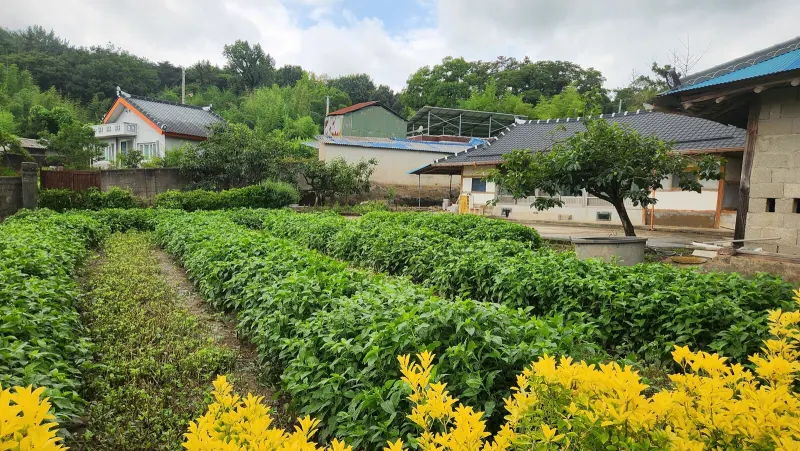
Namyeom (남염, 藍染) is the Korean craft of dyeing with indigo, the plant Koreans call jjok (쪽). Its blue, jjokbit (쪽빛), remains part of everyday language: Koreans still speak of a "jjok-blue sky" and a "jjok-blue sea."
For more than a thousand years indigo carried a double meaning. For the state, blue was the color of the east, the direction that Korea occupied in the cosmic order, and rulers from Goryeo to the late Joseon repeatedly ordered their people to wear it instead of white. For ordinary households, indigo was the most practical of dyes: the color of working clothes, a bride's quilts, wrapping cloths and book covers, and a source of income for farming families along the rivers of the south.
This record traces that history, from the first records of indigo on the peninsula, through the court and the home, to the near-extinction of the craft after the Korean War and its revival in Naju. The dyeing technique itself is documented separately.
I. What namyeom is: the plant and its blue
Korean indigo comes from Persicaria tinctoria (formerly Polygonum tinctorium), an annual of the knotweed family known in Korea as jjok (쪽), nam (藍) or yoram (蓼藍). It is native to southern China and Vietnam and spread from there to Korea, Japan and beyond. In China it was already in use in the Western Zhou period (c. 1045 to 771 BCE), and it remained East Asia's main blue dye until tropical Indigofera arrived from the south.
Indigo is a pigment found in several unrelated plants. Worldwide, at least seven major dye plants contain it, among them Indian indigo (Indigofera tinctoria), European woad (Isatis tinctoria) and the Strobilanthes indigo of southern China and Okinawa. Korea relied on the knotweed indigo, which grows well in a temperate climate.
Two kinds were grown in Joseon: native indigo (향람종) and Chinese indigo (당람종). Chinese indigo was being harvested by 1459, and by the early nineteenth century it was prized for its round, thick leaves and strong color.
Bluer than indigo
The Confucian philosopher Xunzi wrote that "blue comes from indigo, yet is bluer than indigo" (青取之於藍而青於藍). The line became the proverb cheongchul-eoram (청출어람): a student who surpasses the teacher.
Korea has its own version. The 『삼국유사』 records the phrase namcheon jeobonsaek (藍茜沮本色), "indigo and madder surpass their source colors," in the story of the Silla monk Uisang. When Uisang grasped the teachings of the Avatamsaka Sutra from his master Zhiyan in Tang China, Zhiyan is said to have remarked that the student had drawn out the hidden meaning, as indigo and madder yield colors deeper than the plants themselves. The metaphor only works if dyeing with indigo was already familiar, which suggests the craft was known in Korea by the Three Kingdoms period or earlier.
Why it was valued
Indigo is the one natural blue that is both deep and fast. Unlike most plant dyes, it holds up well to washing and light. It is also thought to repel insects, which is why it was used to dye paper as well as cloth. It also needs no mordant, and a single dye bath can give shades from pale jade to near-black depending on the number of dips.
II. Three Kingdoms and Goryeo: blue appears
Early records
A line in the Hou Hanshu account of the Eastern peoples, read as referring to blue garments, may show that the Samhan were already dyeing with indigo. It rests on a single garbled passage, but it would place blue dress in the peninsula's earliest written record.
The Three Kingdoms offer firmer ground. Goguryeo's high officials wore caps of blue silk (청라관), silk dyed with indigo and trimmed with bird feathers and gold and silver. The Baekje king wore a purple robe over blue trousers (청색고). In Silla's seventeen-grade rank system, officials of the tenth and eleventh grades wore blue robes. Blue in these systems was a middle color: below purple and red, above yellow.
Silla ran specialized dye offices under the palace workshop bureau. Among them was a blue-dye office, alongside the red-dye office (홍전) and the sappanwood office (소방전).
Goryeo
Goryeo organized dyeing through the Office of Dyeing (도염서) and the royal wardrobe office (장복서), which employed dye-makers and dyers. Indigo appears in Goryeo law: under King Myeongjong, in 1189, a candidate who sat the civil examination wearing an indigo robe (藍衫) was barred from sitting it three times.
Indigo paper and the sutras
Goryeo also used indigo on paper. Copying Buddhist scripture by hand was an act of merit, and the finest sutras were written in gold or silver on paper dyed deep indigo, known as gamji (감지, 紺紙). A sutra in gold on indigo paper was a gamji geumni (감지금니), in silver a gamji eunni (감지은니).
By the later Goryeo period the state ran a Sutra-Copying Office (사경원) with separate bureaus for gold and silver scripts. Many of these gold- and silver-on-indigo sutras survive, several designated National Treasures.
Making gamji was demanding. Hanji absorbs several times more dye than silk, and a deep navy took dozens of dippings. No written record of the technique survives, and modern attempts by paper-makers, dyers and conservators have struggled to match the depth and texture of the originals.
Blue as the color of the east
In 1275, under King Chungnyeol, an official memorial argued that the east corresponds to the element wood, and that its proper color is therefore blue. White, the color of metal, had become common since Mongol-style dress was adopted, and metal "overcomes" wood in the five-phase cycle. The memorial asked that white clothing be forbidden, and the king agreed.
The same reasoning, that Korea lay in the east and its proper color was therefore blue, reappears in court debates throughout the Joseon period.
III. Joseon: the state's blue and the people's white
The color of the east
Joseon was built on Neo-Confucian cosmology, in which the five colors correspond to the five phases and the five directions. Blue (청) belonged to wood, spring, the east, and the virtue of benevolence. Korea lay to the east of China, and so, by the logic of the system, its people ought to wear blue.
The Joseon court returned to this argument again and again. Taejo, Sejong, Yeonsangun, Injo and Hyeonjong all encouraged blue clothing, and Sukjong went as far as issuing it as a royal command. The same bans that tried to reserve red for the king also tried to replace white with blue for everyone else.
Blue in official dress
Blue was built into the ranks of government. Under the system codified in the Gyeongguk Daejeon and restated in later codes, officials wore red from the first to the third rank, blue from the fourth to the sixth, and green from the seventh down.
| Rank | Robe color |
|---|---|
| 1 to 3 (upper) | Red (홍포) |
| 4 to 6 (middle) | Blue (청포) |
| 7 to 9 (lower) | Green (녹포) |
Before the reign of Seongjong, the crown prince wore green and the body of officials wore acheong (아청), a deep blue; the skirts of queens and queen dowagers were indigo silk with gold-stamped borders. Unlike daehong red, blue was never reserved for the few. It was worn from court officials and scholars down to commoners, and the ceremonial dopo overcoat of the scholar was often blue.
The people's white
Many people did not follow these orders. Despite repeated bans on white, commoners kept to white clothing or pale jade-blue (옥색), and preferred them to the state's blue.
Other evidence points the other way. Yi Ok, a nineteenth-century writer from Chungcheong, claimed that Korea honored blue and that most people wore it. Men, he wrote, rarely wore white without reason except in their outer robes, and women, who treasured their skirts, avoided white most of all, wearing blue skirts unless they wore red or indigo. In the painting of King Jeongjo's procession to his father's tomb at Suwon, many commoners wear blue skirts that appear to be indigo-dyed.
The two kinds of evidence are hard to reconcile fully. Official records describe a population attached to white, while Yi Ok and the court paintings show blue in wide use, at least among women and in some regions. Both may be accurate for different places, classes and periods.
White becomes a national symbol
The tension outlived Joseon. By the late nineteenth century Western visitors were calling Koreans the "white-clad people," and under Japanese rule Koreans adopted the name themselves: "the white-clothed nation" (백의민족) became a symbol of Korean identity. The colonial government, meanwhile, campaigned against white clothing as unhygienic and wasteful and pushed colored clothes, with dyeing classes across the country. The colonial campaign did not favor blue in particular. It promoted dark, dyed clothing in general, for economic and political reasons rather than cosmological ones.
IV. Indigo at court
The blue dyers
The Gyeongguk Daejeon (1485) lists the court's craftsmen by office. Indigo dyers (청염장) served in two of them:
| Office | Role | Blue dyers | Red dyers |
|---|---|---|---|
| Sangeuiwon (상의원) | Royal clothing and palace goods | 10 | 10 |
| Jeyonggam (제용감) | Cloth for state use and royal gifts | 20 | 10 |
The Jeyonggam, which dyed cloth for the government rather than the royal family, had twice as many blue dyers as red. The difference suggests that government use required more blue cloth than red.
The system changed over time. By the late nineteenth century the Jeyonggam had no craftsmen left, as state workshops gave way to private trade. The Sangeuiwon's dyers lasted to the end of the dynasty: in 1895 the royal wardrobe still had an indigo dyer, Jo Bong-wan, who had for years grown indigo on a plot behind the military training office in the capital.
The court's own indigo fields
Indigo reached the court in a different form from the other main dyes. Safflower, gromwell and sappanwood came in as finished dyestuffs, but indigo came in as seed, which the court then grew itself.
The court kept indigo fields (남전, 청대전) near the palaces, along the Han River, and in Gaeseong. In 1522 the royal wardrobe's field at Jeongot, today's Haengdang-dong in Seoul, flooded; the replacement land was scattered and unsuitable, and officials asked to buy private fields instead. In the seventeenth and early eighteenth centuries the court also kept indigo fields in Gaeseong.
Because their harvest went to the royal household, these fields were exempt from ordinary taxes. They were managed by the palace farm office (내농포), run by eunuchs, and worked by commoners. At harvest time in summer, the eunuchs oversaw carting the indigo into the palace, and in 1791 they were accused of illegally conscripting local runners to clear the roads while they did so.
Indigo ice
Much of the court's indigo dyeing used fresh leaves, and fresh-leaf dyeing needs ice to keep the juice from oxidizing in summer heat. Indigo ice (남빙) was therefore a standing item in the palace ice budget. Whenever the royal ice houses ran short, as in 1637, 1700 and 1703, officials proposed cutting two uses first: the ice distributed to officials, and indigo ice.
In 1700 the court drew a clear line between two kinds of indigo dyeing at court: "indigo dyeing within the palace" (궐내 염람), supplied from the inner ice house, and the royal wardrobe's indigo ice (상방 남빙), supplied from the western ice house.
Palace women and private dyers
Not all court dyeing was done by professional craftsmen. The Sangeuiwon's dyers handled garments for birthdays, festivals and ceremonies; everyday clothing was dyed within the palace quarters by the palace women of the sewing and embroidery rooms. In 1722 a palace woman of the sewing room left the palace twice on indigo-dyeing business. Each palace received indigo seed as part of its annual supplies.
Some work went outside. The court paid a fee of three jeon per bolt for dyeing blue cotton, cloth more common in private than royal dress, which was sent to specialist indigo dyers in the capital. By the late Joseon period, Hanseong had several such workshops, and the royal household was sometimes among their customers.
V. The names of blue
Because one plant can give so many shades, Korean has a large vocabulary of indigo blues. In the traditional color system of five pure colors and five intermediate colors, blue (청) was one of the pure colors, and it was produced with indigo.
Blues from indigo
| Name | Korean | Character |
|---|---|---|
| Okssaek | 옥색 | Jade blue; the palest dip, the favorite of commoners and scholars |
| Haneulsaek | 하늘색 | Sky blue |
| Jjokbit | 쪽빛 | The clear blue of indigo itself |
| Cheongsaek | 청색 | Blue; the pure color of the east |
| Byeoksaek | 벽색 | Clear blue-green, the color of jade stone |
| Namsaek | 남색 | Deep indigo |
| Banmul | 반물 | Dark indigo, the everyday color of women's skirts |
| Simcheong | 심청 | Deep blue |
| Geompureun | 검푸른 | Blue-black |
| Gamsaek | 감색, 紺 | Dark navy; the color of gamji, sutra paper |
| Acheong | 아청 | Very dark blue, used for official dress |
| Galmae | 갈매 | Dark greenish blue |
The indigo colors also include several greens, because overdyeing indigo with a yellow dye was the standard way to make green.
Greens
No plant gives a fast green on its own, so Korean dyers made green by combining indigo with a yellow dye such as gardenia, pagoda-tree flower or the grass sambo. At court, sambo was used to dye the greens called yucheong (유청) and chorok (초록), with the depth of the indigo deciding the shade. Other greens made this way included nokssaek (녹색), yurok (유록, willow green) and durok (두록, bean green).
Indigo in the language
Indigo dyeing had largely disappeared from daily life by the mid-twentieth century, but its vocabulary remains in use. Koreans still speak of a "jjokbit sky" and a "jjokbit sea," and cheongchul-eoram, blue from indigo, remains a common expression. The word namsaek is the standard Korean name for indigo in the spectrum.
VI. Uses
Indigo was used at every level of Korean society, from the court to farming households.
Dress
- Official robes. Blue robes for the middle ranks of government, and deep acheong for officials' dress in early Joseon.
- The scholar's coat. The dopo overcoat of the yangban scholar was often blue.
- Women's skirts. Royal women wore indigo silk skirts with gold-stamped borders. Ordinary women wore dark banmul skirts, and many of the commoners in Jeongjo's Suwon procession painting wear blue.
- Jade-blue. Pale okssaek was the compromise between the state's blue and the people's white, worn by scholars and commoners alike.
The household and the bride
Only wealthy families could keep indigo-dyed cloth in quantity, and indigo bedding was among the goods a bride most hoped to bring to her new home. In Naju, until 1945, a bride was expected to bring an acheong quilt (아청이불), a deep indigo coverlet. Indigo also colored wrapping cloths (보자기), pillow covers and everyday garments. Many Naju families still keep indigo-dyed quilts and pillowcases passed down from their grandparents.
At weddings, red and blue appeared together. The cheongsachorong (청사초롱), the red-and-blue silk lantern that lit the way for a Joseon wedding, paired the two colors as yin and yang.
Paper and books
Indigo's reputation for repelling insects made it the dye of choice for protecting paper. It was used to dye hanji, to back and mount paintings and calligraphy, and for book covers, including the covers of royal records. The indigo paper of the Goryeo sutras (gamji) is the best-known surviving example.
Medicine
The processed leaf, cheongdae (청대, 青黛), was used in traditional medicine. It is cold in nature and was prescribed to clear heat and toxins; it was a standard item in Joseon prescriptions. Today it appears in remedies for skin conditions. The leaves and seeds were also used medicinally.
What survives
Surviving indigo objects include court and scholars' dress, military coats, shoes, book covers, jackets and quilts. Master Jeong Gwan-chae has built a collection of such pieces as reference for reproducing traditional colors.
VII. Naju and the Yeongsan River
Indigo was grown across the southern half of the peninsula, but by the modern period its best-known center was Naju, on the Yeongsan River in South Jeolla. Six conditions made the craft flourish there.
Why Naju
- Soil and climate. Indigo likes rich soil, warmth, sun and water. The alluvial plain of the Yeongsan gave all four.
- Floods. The Yeongsan flooded often in the summer rains, ruining rice and other crops. Farmers turned to indigo because it tolerated flooding, could be harvested before the monsoon, and paid well. In Naju, indigo was first of all a crop that could survive the floods.
- Water and shells. Making indigo paste takes large quantities of water and lime. Naju had the river, and the coast nearby supplied the oyster and cockle shells that were burned for lime.
- Silk and cotton. Naju had long grown mulberry and cotton, and in the modern period became the country's largest producer of raw silk; a Japanese-owned silk factory opened there in 1910 and at its height employed over a thousand people. Autumn fields along the river were said to look snow-covered with cotton. All that cloth needed dyeing.
- Official demand. Naju was the administrative center of the southwest from Goryeo through Joseon. The magistrate's office and its officials needed robes and dyed cloth, and a prosperous town grew up around them.
- A market. Naju sat where the produce of the plain met goods brought upriver by boat. Its markets drew traders from across the southwest, and indigo dye and dyed cloth from Naju were sold far beyond the region.
The indigo trade
In the early twentieth century, the landing at Yeongsanpo was crowded with buyers who came for Naju's indigo from across Korea, and even from Japan and China. Until 1945, demand for indigo quilts as bridal goods was so strong that more and more farmers planted indigo instead of rice and field crops, and the authorities are said to have restricted it.
The craft stayed in daily use well into living memory. In 1976, of 35,423 men and women aged 53 and over surveyed across the country, 5,326, about 15%, still knew how to make indigo dye and dye with it. Indigo dyeing had been a common household skill in the early twentieth century, when they were young.
Saetgol
Saetgol, in Dasi-myeon, sits where the Yeongsan plain meets the tidal water of the river. It is known as "the twelve villages of Saetgol," a cluster of hamlets, some with houses centuries old, including Jeongga, Yonghong, Huseok, Dongsan and Sambong. Most of them dyed with indigo into the mid or late 1950s. In Seochang, three or four households still dyed at the end of the 1940s; Sambong dyed until about 1955; Yonghong grew indigo and dyed until the early 1960s.
Saetgol was also a weaving village. Its hand-woven cotton, Saetgol nai (샛골나이), is National Intangible Cultural Heritage No. 28. The house where Jeong Gwan-chae was born, in Jeongga village, still stands.
VIII. Loss and revival
Synthetic dyes
In 1856 William Henry Perkin produced the first synthetic dye in England, and within decades synthetic colors had begun to replace natural ones worldwide. After Korea's ports opened in 1876, aniline dyes, alizarin and synthetic indigo, most of them German and later Japanese, were sold alongside natural dyes. They were cheaper and faster to use, and they needed no fields, no lime kilns and no weeks of fermentation.
Colonial rule and the Korean War
Under Japanese rule, the colonial government's campaign for colored clothing spread commercial dyeing, not traditional indigo. During and after the Korean War, around 1950, indigo cultivation almost stopped across the country. Naju held on longer than anywhere else, but by the 1960s the line was broken there too. Chemical fibers and dyes replaced homespun cloth and home dyeing, and the seed itself disappeared.
The seeds
The revival began with seed. In 1975 the folklorist Ye Yong-hae (1929 to 1995) obtained indigo seed and passed it to Park Bok-gyu, then a lecturer at Mokpo University's College of Fine Arts, who in turn gave it to Kim Jae-guk in Gahong-ri, Dasi-myeon, a village that had grown indigo into the 1960s. Ye told Park that if indigo were to be brought back anywhere in Korea, it would be in Naju.
In 1978 Park gave seed to one of his students, Jeong Gwan-chae, a Naju native. Jeong gave it to his mother, Choi Jeong-nim (1928 to 1995), who had grown indigo, made paste and dyed with it as a young woman, having learned from her mother-in-law and her own mother, Lee So-rye (1905 to 1998). With her knowledge, the plants grew, the paste was made, and cloth was dyed. In 1984 Jeong and Park brought a length of indigo-dyed cotton to Seoul to show Ye Yong-hae, who exclaimed, "So this is what jjokbit looks like!"
In neighboring Munpyeong-myeon, Yun Byeong-un (1921 to 2010) revived the craft of his own family. Born in Myeongha village on a tributary of the Yeongsan, where indigo dyeing had once been common, he had begun dyeing at 13, the fourth generation of his family to do so. After the war he brought indigo seed back from Japan, and succeeded in germinating it, saving seed and fermenting a vat.
Designation
In 2001 the state designated Yeomsaekjang (염색장, master dyer) as National Intangible Cultural Heritage No. 115, recognizing indigo dyeing specifically, and named both Yun Byeong-un and Jeong Gwan-chae as its first holders. At 42, Jeong was then the youngest holder in the crafts. Yun died in 2010; his son Yun Dae-jung continues his line as a transmission instructor.
Naju built on the designation. In 2006 the city opened the Natural Dyeing Culture Museum on the Yeongsan riverbank in Dasi-myeon, a museum devoted to natural dyeing. Jeong's transmission center, close by, grows its own indigo and produces its own paste, lime and lye.
Indigo today
The craft survives, but its economics are fragile. Natural dyes now account for a tiny share of all dyeing, by Jeong's estimate around 0.01%. By 2026, 53 people had completed training under Jeong, and his son Jeong Chan-hee represents the fifth generation of the family. Yet traditional dyeing demands months of labor and rarely earns a living, and many trainees leave. Jeong has argued that designation is not enough: transmission requires a structure in which teaching, exhibiting and selling can support those who choose the work.
Jeong sees a future for the craft in contemporary fashion and design, noting that indigo is familiar worldwide as the color of denim. In 2025 Saetgol held its first indigo festival, with plans to turn the village itself into a place to experience the blue of the Yeongsan.
Appendix: Chronology
| Date | Event |
|---|---|
| c. 1045 to 771 BCE | Indigo in use in Western Zhou China |
| Three Kingdoms | Goguryeo officials' blue silk caps; Baekje king's blue trousers; blue for Silla's 10th and 11th grades |
| 7th c. | Uisang story in the Samguk Yusa uses indigo as a metaphor for the surpassing student |
| 1189 | Goryeo bars examinees in indigo robes |
| 1275 | Goryeo bans white clothing; blue declared the proper color of the east |
| Later Goryeo | State Sutra-Copying Office; gold and silver sutras on indigo paper |
| 1459 | Chinese indigo harvested in Korea |
| 1485 | Gyeongguk Daejeon: 10 indigo dyers at the Sangeuiwon, 20 at the Jeyonggam |
| 1522 | Royal wardrobe's indigo field at Jeongot floods |
| 1628, 1711 | Court indigo fields in Gaeseong |
| 1700 | Court distinguishes palace indigo dyeing from the royal wardrobe's indigo ice |
| 1722 | Palace woman leaves the palace on indigo-dyeing business |
| 1750 to 1751 | Sangbang Jeongrye: indigo supplied to the court as seed |
| 1809 | Gyuhap Chongseo describes fresh-leaf dyeing with ice |
| 1856 | Perkin's first synthetic dye |
| 1876 to 1910 | Synthetic dyes enter the Korean market |
| 1895 | Jo Bong-wan serves as royal wardrobe indigo dyer |
| Early 1900s | Buyers from Korea, Japan and China crowd Yeongsanpo for Naju indigo |
| 1910s to 1930s | Colonial campaign against white clothing |
| c. 1950 | Korean War; indigo cultivation nearly ceases |
| 1960s | Last traditional cultivation in Naju |
| 1975 | Ye Yong-hae obtains indigo seed |
| 1976 | Park Bok-gyu's survey: 15% of Koreans over 53 know indigo dyeing |
| 1978 | Jeong Gwan-chae receives seed and learns from his mother |
| 2001 | Yeomsaekjang designated National Intangible Cultural Heritage No. 115; Yun Byeong-un and Jeong Gwan-chae named holders |
| 2006 | Natural Dyeing Culture Museum opens in Naju |
| 2010 | Yun Byeong-un dies |
| 2025 | First Saetgol indigo festival |
References
Primary sources
- Jeong Gwan-chae. 『쪽(藍) 재배와 쪽물 염색』 [Indigo Cultivation and Indigo Dyeing], chapters 1 to 3.
- Samguk Sagi (『삼국사기』); Samguk Yusa (『삼국유사』); Goryeosa (『고려사』), vol. 85. Samguk SagiSamguk YusaGoryeosa, vol. 85
- Joseon Wangjo Sillok; Seungjeongwon Ilgi; Gyeongguk Daejeon (1485); Sangbang Jeongrye (1750 to 1751). Joseon Wangjo SillokSeungjeongwon IlgiGyeongguk DaejeonSangbang Jeongrye
- Jeon Sun-ui (1459). 『산가요록』. Bingheogak Yi-ssi (1809). 『규합총서』. Seo Yu-gu. 『임원경제지』. Heo Jun. 『동의보감』. 산가요록 (encyclopedia)규합총서임원경제지동의보감
Studies
- Kim Soon-young (2008). "The Transition of the Indigo Dyeing Method Identified through the Agricultural Archives in the Latter Joseon Dynasty." Journal of the Korean Society of Clothing and Textiles 32: 1286–1298. DOI
- Kim Soon-young (2010). "Dyes and Dyeing in Korea, from 1876 to 1910." Journal of the Korean Society of Costume 60(9): 77–94. KoreaScienceRISS
- Kim Soon-young (2013). "The Dyeing Culture of Royal Garments in the Late Joseon Dynasty." Fashion & Textile Research Journal 15(2): 192–201. DOIKCI
- Park Bok-gyu (1977). 「한국쪽물 염색에 대한 연구」. MA thesis, Hongik University. RISS
- Park Chan-seung (2014). 「일제하의 '백의(白衣)' 비판과 '색의(色衣)' 강제」. 동아시아문화연구59: 43–72. DOI
- 「고려말 사경의 감지(紺紙) 재현과 수리: 이화여자대학교 소장 감지은니묘법연화경을 중심으로」. KCI. DOIKCI
Institutional and press
- Korea Heritage Agency (2021). 「염색장 정관채」; 「염색장 윤병운」. 국가유산이야기. 염색장 정관채염색장 윤병운
- Korea Heritage Service (2013). 「청출어람인 쪽 염색」. 월간 국가유산사랑. Read online
- National Institute of Korean History. 「백의민족의 유래와 의미」; 「백의금지와 색의권장」; 「고려시대 사경」. 우리역사넷. 백의민족의 유래와 의미백의금지와 색의권장고려시대 사경
- Namdo Ilbo (2026). "영산강에 다시 물든 파란 쪽빛." 10 May. Read online
- Hankyung (2022). "한민족이 백의민족이 될 수밖에 없었던 이유는?" Read online
- Nippon.com. "Japanese Indigo, a Living Tradition." Read online
How to cite
Park, Haram Jackson. “Jjok: A Cultural History of Korean Indigo Dyeing.” Dyeing the Dying History. https://dyeingthedyinghistory.com/indigo/cultural-history.